

A Originally named “contrology” by its creator, Joseph pilates, the pilates method is a holistic system of physical and mental conditioning. It focuses on core strength, precise movement and breathwork to harmonize the mind and body. The basic principles of Pilates are: Centering, control, concentration, precision, breath and flow.
More than just a workout, pilates is a holistic form of exercise that strengthens the body while calming the mind. From improving posture, flexibility and core strength to enhancing sports performance and reducing the risk of injury, its benefits extend well beyond physical fitness. The focus on mindful movement and breathing also supports better sleep and overall well-being, serving as a workout that is suitable for all ages and abilities.
The most popular forms of Pilates are Mat Pilates which includes floor-based bodyweight exercises, Reformer Pilates which uses a spring-loaded apparatus for resistance.
Mat Pilates is a workout that uses mostly your own body weight and gravity to build strength, flexibility, and endurance. It relies on precise, controlled movements that target the entire body, with a heavy emphasis on your core.
Reformer Pilates is an adaptable machine full of possibilities that is perfect for beginners, challenging for the avid fitness enthusiast, and suitable for those recovering from an injury. Using a Pilates reformer may provide similar benefits as mat Pilates, improving strength, endurance, mobility, and flexibility. The reformer efficiently builds muscular endurance in a non-weight-bearing manner, making it more comfortable for the joints.
Benefits of Pilates:
Core strengthening
Posture correction
Better sleep pattern
Mind-body connection
Improved neuroplasticity
Improves sports performance
Boosts immunity
Better flexibility and movement
Prevent injuries
Strengthens the back.
1. Hundreds:
Step 1: Lie flat on your back on a mat. Bend your knees to 90 degrees (tabletop position) and press your lower back firmly into the floor so there is no arch.
Step 2: As you exhale, pull your belly button in (This engages your core and minimises the space between the arch of your back and the floor) tuck your chin slightly, and curl your head and shoulders off the floor until you are looking directly at your abdominals.
Step 3: To increase the challenge, straighten your legs diagonally toward the ceiling. Keep them higher for less strain (a 45-degree angle) or lower to the ground for an advanced workout. Hover your arms a few inches off the mat
Step 4: Vigorously pump your arms up and down (as if splashing water) for a total of 100 times
Please note: Breathing pattern – Coordinate your breath with your pumps. Inhale for 5 pumps, and exhale for 5 pumps. Repeat this cycle 10 times to hit the 100 mark.
2. Leg raises:
Step 1: Lie flat on your back on a mat. Press your lower back into the mat and draw your belly button in toward your spine. Float your legs straight up to a 90° angle.
Step 2: Inhale as you slowly lower your legs toward the floor. Stop just before your lower back arches or lifts off the mat.
Step 3: Exhale, deeply engaging your core, and lift your legs back up to the starting position
Please note: Repeat this exercise for 10-12 counts. Ensure the back does not raise from the floor at any point to avoid any strain. You can hold the Step 2 position for upto 10 counts after completing the rep cycle to make it more intense.
3. Side lying leg raises:
Step 1: Lie on your side, creating one long, straight line from your head to your toes. Place your head on your outstretched arm.
Step 2: Stack your hips and shoulders directly on top of one another. Place your top hand on the mat in front of your chest for support.
Step 3: Engage your core. Inhale to point your toes and lift the top leg slightly above hip height. Exhale, flex your foot, and slowly lower the leg back down.
Please note: Aim for 10-15 controlled repetitions on each side. You can hold the position for upto 10 counts and add 5-8 pulses after completing the rep count to make the exercise more intense.
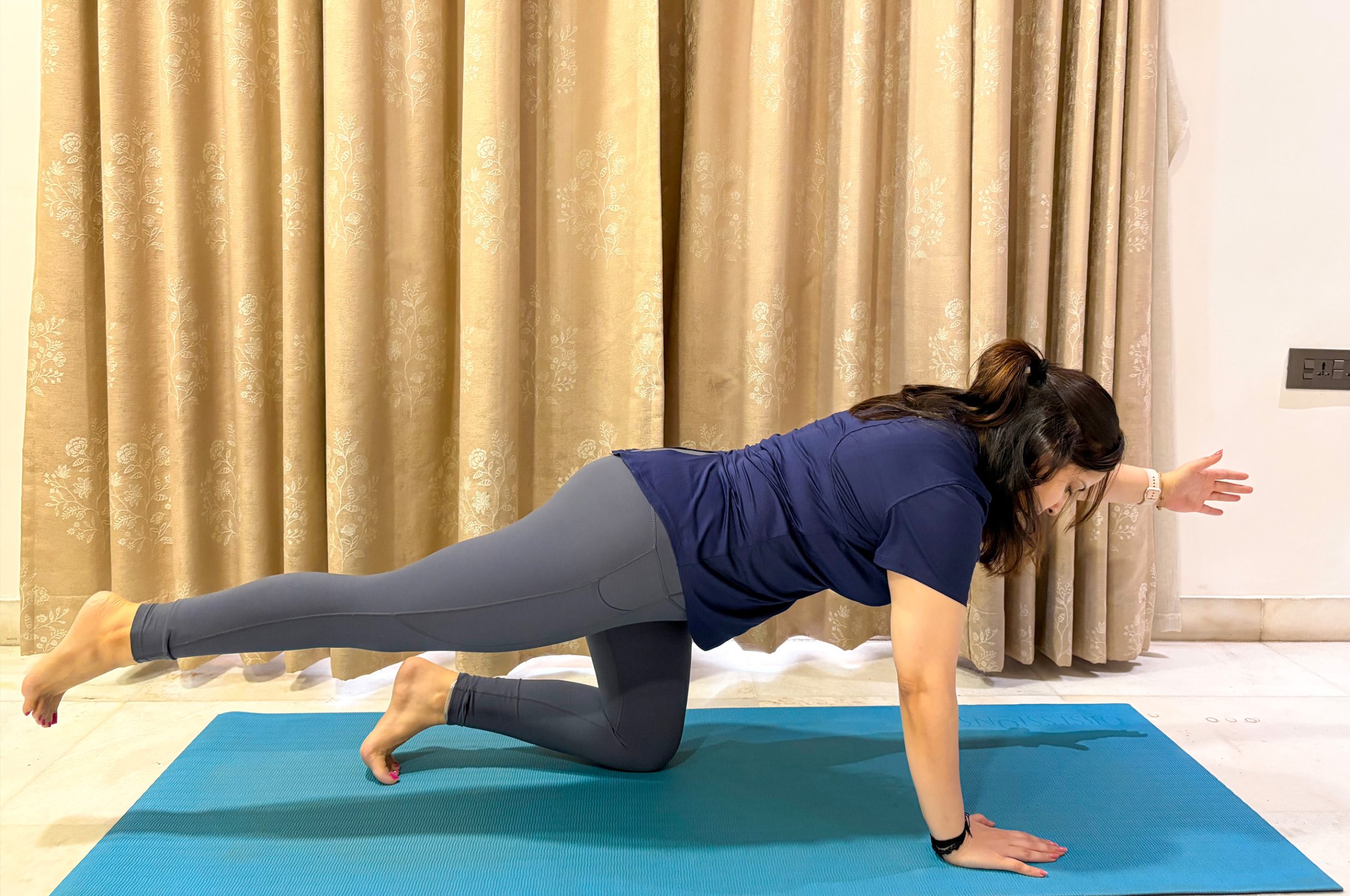
4. Bird dog:
Step 1: Kneel on a mat with your hands directly under your shoulders and your knees directly under your hips. Keep your spine neutral and engage your abdominal muscles.
Step 2: Slowly extend your right arm forward and your left leg backward. Keep your fingertips reaching forward and your toes pointed straight behind you.
Step 3: Slightly lift your extended arm and leg in line with your back, ensuring your hips stay perfectly square to the floor. (Squared hips – Squaring the hips means aligning both hip points to face forward keeping them level without twisting or dropping one side)
Step 4: Slowly lower your arm and leg back to the starting position, maintaining core control, and switch to the opposite side
Please note: Recaliberate if the back starts to arch at any point. Repeat the workout for 10-12 counts. You can add a hold for upto 10 counts after completing the rep cycle on Step 2 to make it more intense.
– Aashna Sarin is a certified Pilates instructor working with Chamiers core, Chennai.