

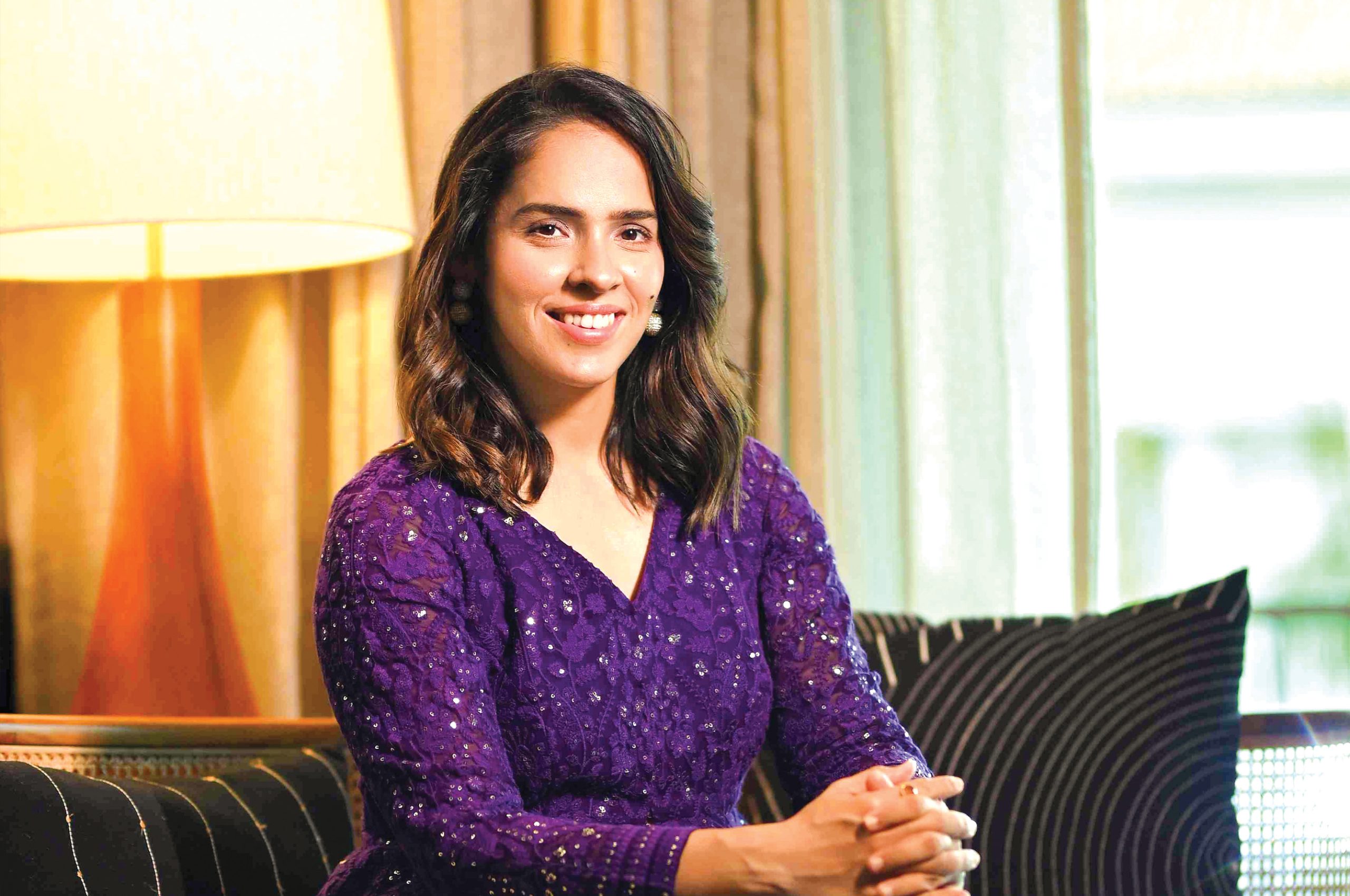
When we texted Saina Nehwal for an interview, she was celebrating her birthday with the person who believed in her long before the tournaments and titles she won; long before she herself knew what she is capable of; long before she became the queen of badminton. Her mother, Usha Nehwal, a former volleyball player herself, is the one who has shaped Saina’s career, starting from a young age; from the very first summer camp, to be precise. So, choosing to travel with her mom to celebrate her birthday this year was special, as Saina tells us. “Throughout my career, she has been my biggest support system. Spending that quality time together, away from the noise, was honestly the best gift I could have asked for. This birthday was very special because I chose to keep it quiet and meaningful.”
Silence has in fact been Saina’s superpower. Her career graph stands testimony to the fact that she always let her racquet do the talking, and nothing could ever distract her from her goal — winning. “I was always quiet, kept to myself. I didn’t want to talk non-stop or make friends. I felt that to cut off from people, not let your mind divert, you had to be quiet, because there’s only one thing I had set my eyes and heart on — to play matches to the best of my ability, win them and bring the trophies home. I was not easily satisfied; I always kept pushing myself to do better and work on my strengths. And I think that paid off. I focused only on myself and my game; you have to, if you want to reach the highest level.”
In an emotional train of thoughts, she travels back in time to share, “I got a chance to represent my country because of my parents. My mother dared to dream that I would be an Olympian one day at a time when very few even picked up the racquet. The graver reality being there was no female shuttler winning titles back then. But I could become World No. 1 because my mother instilled that belief in me. And my father took loans early in my career to buy equipments. I could become the player that I am because of them.”
In fact, not many people know that Saina’s elder sister Abu Chandranshu Nehwal was also a player for sometime. “She tried to play, but she has asthma, so she couldn’t continue. She eventually went on to do B. Pharmacy. Also, she was not someone who wanted to play, and you cannot push a person who doesn’t like sports as much. However, she’s always supported me. Whenever I won titles, I came back with some good results, she told me she is so proud of me. And whenever I lost matches, she would encourage me and be very positive, saying, ‘You will do well, you are strong’,” Saina shares.
Who wouldn’t be proud of Saina, for scaling the heights one can only dream of. The shuttler however insists, “Manifestation does come true. Dream, work hard and believe, and it will definitely come true, or you’ll come closer to it, for sure.”
Winning the Olympic medal was “definitely one of the most emotional moments of my life,” she says. “It wasn’t just about standing on the podium — it was about years of sacrifice, failures, and belief finally coming together. I remember feeling a deep sense of gratitude in that moment. It’s something I will carry with me forever.”
Like any other sportsperson, Saina has had her share of ups and downs, but in a true sportsman spirit, she chooses to see setbacks differently. “I truly believe every setback had a purpose. The losses, the injuries, the tough phases — they shaped my mindset and made my victories more meaningful. Of course, as an athlete, you always feel ‘I could have done better’, but today, I see those moments as lessons, not regrets,” she emphasises.
If there is something that Saina strongly believes in, it is mental training, especially in the age we are living in. “It is very important for sportspersons, because there’s a lot of stress when you play at the highest level. I’m talking about top 10-15. When you have so many tournaments and have been playing at the highest level for almost 20-21, years, you are always under pressure. Here is when a mental trainer is needed, someone you can open up to and feel lighter; to talk about all the difficulties during training or about your matches or your opponents, or just how you’re feeling. If a coach can do it, that’s really good. But I do think it is tough for a coach to sometimes understand what you are feeling deep inside, and he might just say, ‘shut up and play’. But a mental trainer can approach/address the same scenario with empathy. We need to understand and acknowledge that every player’s mindspace is different. All minds don’t work the same way. I am glad that players today have trainers, physios, mental trainers, good dietitians — a whole team,” she explains.
Saina also insists that mental trainers are required even after a player stops playing. She reasons, “After you have retired, there will be moments when will feel the urge to play but quickly realise that you’re not able to (because of various reasons); and that can bring in a lot of irritation. In moments like these, it’s always easy to open up to mental trainers or counsellors. In fact, not just sportspersons, I think in today’s world, we all need mental trainers. It’s a necessity now — for me, for you, for everyone.”
Saina may have exited the court, but the years that she has given the sport, winning tournaments, bringing home medals and laurels alike, and putting India badminton on the world map, will forever remain etched in history, a reminder that hers is one of the most significant contributions made to the sport. “I entered the court when I wanted to, and I retired when I thought the time had come,” Saina says. A thoughtful pause later, she adds, “Of course, I wanted to play more, but I could see my body struggling, my knee swelling; and doctors told me it’s arthritis…”
The decision to retire didn’t come easy. It took Saina more than a year to try everything possible to stay on court — push her limits, bear the pain, consult doctors — before she could tell herself ‘It’s time’. Saina calls the process — of learning, acknowledging, realising, and finally admitting that she has to stop playing, “painful and emotional”. “I have played for so long that my mind does not think of anything but badminton. Even if I were to have a conversation outside the sport, after a while, I start thinking ‘what else do I talk?’ and then I immediately begin to ponder over all my games. In fact, now that I have time, I have been watching videos of my old matches and recollecting all those memories… Badminton is my identity and it will always be — it has given me everything. So, yes, I have fought, been aggressive and emotional in front of parents before I let it sink in that yes, this is it. That’s when I announced my retirement… I didn’t want to play just for the sake of continuing. I didn’t want to play if I couldn’t be in the top 10 or 15 because my body was giving up,” she shares.
The strong-headed, focused, with a fiercely fighting spirit, Saina was able to embrace the change and move on. “Sports teaches you that; it gives you the strength to look forward, to move ahead. Now I want to give back to the sport in a meaningful way. Working with young athletes, building a strong ecosystem, and sharing my experience is something I’m really passionate about. At the same time, I’m also looking forward to discovering life beyond competition.”
And she really is! Going by the number of trips she has been making to some very interesting places and sharing those special moments online, Saina is living it up! “Yes, I think I’ve discovered a new side of myself. Earlier, travel was always about tournaments and performance, so I never really paused to experience places although I travelled a lot. But now, travelling feels different. I enjoy the freedom of exploring — whether it’s the calm of nature or the culture of a city.”
Letting us in on the places she is excited to explore, Saina shares, “Europe is definitely on my list, and I also want to see more of India. The most beautiful memories so far are the simplest ones — just being present, without any pressure.”
The onus to take badminton higher, now lies on the youngsters who have been inspired to pick the sport after watching Saina Nehwal play all these years. And for all of them, Saina has a message to share — “Work hard, be disciplined, you may have to make a lot of sacrifices, but when you reach your goal, you will know everything was worth it.”