

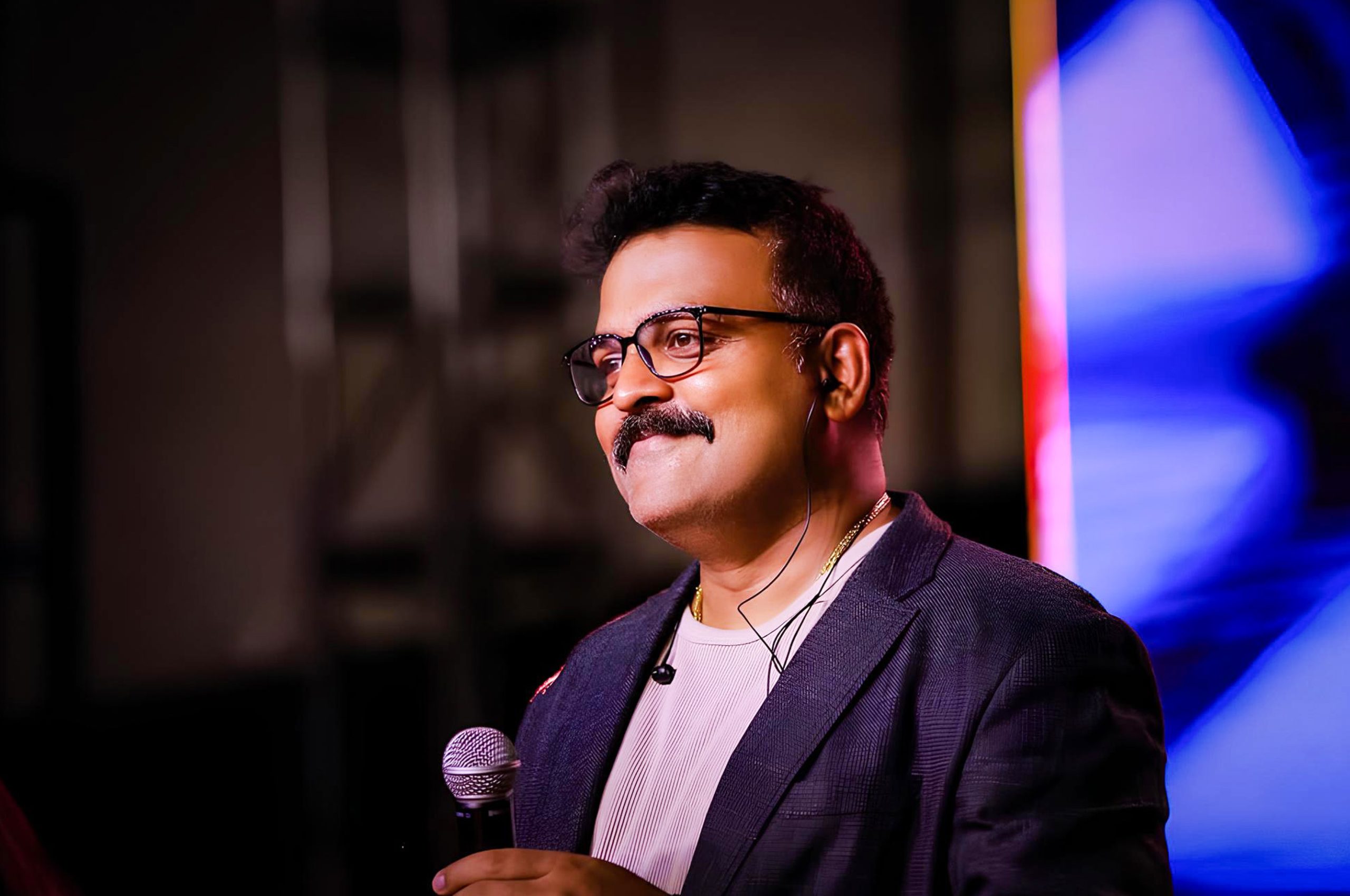
Imagine having a soulful voice but living in the shadow of a legend, constantly striving to carve your own identity. Not overshadowed by a rival, but by your own father. Yet, Yugendran, son of the legendary Malaysia Vasudevan, refuses to let that weight dim his light. Instead, he fights through it with a smile, proudly declaring, “I am a positive person.”
After a few detours, Yugendran has now found his rhythm in New Zealand, where he lives with his lovely family. But his heart remains close to Tamil cinema. Following an 11-year hiatus, he made a striking return to the silver screen alongside Vijay, and that’s just the beginning. In this candid conversation, he radiates both positivity and perspective, reflecting on identity, legacy, and love.
What was it like growing up as the son of a celebrated singer?
If you ask me, SPB Charan, or Venkat Prabhu, we’d all agree, being a celebrity’s son comes with both its boon and bane. Back in school, my dad rarely came around, even for PTA meetings; it was always my mom. Everyone knew whose son I was. Sometimes that felt okay, and sometimes it didn’t. People tend to assume you’ve got everything sorted just because of your surname, ‘Oh, you’re Malaysia Vasudevan’s son!’ — but it doesn’t always work that way. In cinema, honestly, it’s mostly been a disadvantage. People often ask, ‘Why can’t your dad produce your film?’ And I’m like, ‘Why should he?’
Tell us about your sons.
My eldest son is Visashan, the middle one is Kishan, and the youngest is Darshan. I’ve tattooed all their names on my arm. Darshan was born two years after my father passed away. He died in 2011, and Darshan came into our lives in 2013. I truly feel he’s my father reborn. It’s as if my dad never really left me.
Did you think of naming him after your dad?
Someone once asked if I had thought of naming him after my father. But that would’ve been difficult — imagine calling out, ‘Dei Vasudeva!’ every day! Instead, we chose the name Darshan, which means divine vision or dharisanam. It felt right — like we were blessed with a glimpse of my father again. I see my Appa’s traits in him — the way he sits, the way he eats. My dad was a big foodie; he would enjoy anything on his plate. And in those little moments, I feel his presence every day
Are you interested in acting or singing?
I actually started off with the mridangam and did my arangetram when I was just ten, in front of Ilaiyaraaja sir. After that, I immersed myself in Carnatic music for about two years, accompanying legends like Yesudas Uncle, Madurai Somu, and Dharapuram Sundarajan. Eventually, I began training in vocals too. But to be honest, I didn’t have much interest back then. All I wanted was to be out playing cricket. I even remember hiding inside a water tank once to escape my master! Over time, though, I slowly found myself drawn into the world of music.
A contemporary singer that you like?
I really love Pradeep Kumar’s voice. Recently, when I was performing at a show in Canada, he happened to be there for another concert. I went up to him and told him how much I admired his voice. He was genuinely touched and said, ‘I love your Appa’s voice.’ I couldn’t help but tease him right away, asking, ‘Oh, so you don’t like my voice?’
How do you balance between identity and legacy?
It’s not easy. People can say it is, but it really depends on how we react. We usually don’t talk about it; in fact, this is the first time I’m opening up about it. Many don’t have the capacity to truly understand.
If I try to explain, some might say, “You’re not up to the mark,” or “You’ll sing only the same kind of songs, right?” It’s not possible to go and clarify to each person that I sing other genres too. Success is relative; you simply can’t compare us both.
One song of your dad’s that you always find yourself humming?
Whenever people talk about Appa’s songs, they immediately bring up the kuthu numbers. But honestly, I don’t like his kuthu songs. Even in my shows, you’ll notice that my setlist mostly features melodies. Raaja sir has given Appa songs across all genres, but I personally love the melodies — especially Kodai Kaala Kaatre from Paneer Pushpangal.
Tell us about some of your favourite songs you’ve sung.
I’ve done a few songs with Bharathwaj sir, and Kizhakke Paarthen from Autograph is one of my favourites. I’ve sung quite a bit in the Cheran–Bharathwaj combination. For instance, Thozha Thozha from Pandavar Bhoomi is another song close to my heart. Cheran sir actually likes my voice a lot.
You have your wife’s name tattooed on your arm. Tell us a bit about your relationship.
If a husband and wife don’t fight, I’d say it’s a waste! (laughs) You need those little fights, only then there’s real compatibility. If someone says, “We never fight,” I start doubting if they’re even a couple!
I can’t go a day without talking to Malini. After a certain age, your true companion is your wife and vice versa. Kids will grow up and have their own lives, so you’ll always need that one person to talk to. There’s a 6-hour 30-minute time difference between here and New Zealand, and she sleeps by 9:30 PM. So, I make sure to call her before that. That’s why I wear a watch set to New Zealand time. I speak to her every day.
Now that you’re in Tinseltown, are there any new projects in the works?
After GOAT, Venkat Prabhu and I are collaborating again. He told me that I’ll be part of his upcoming directorial with Sivakarthikeyan.