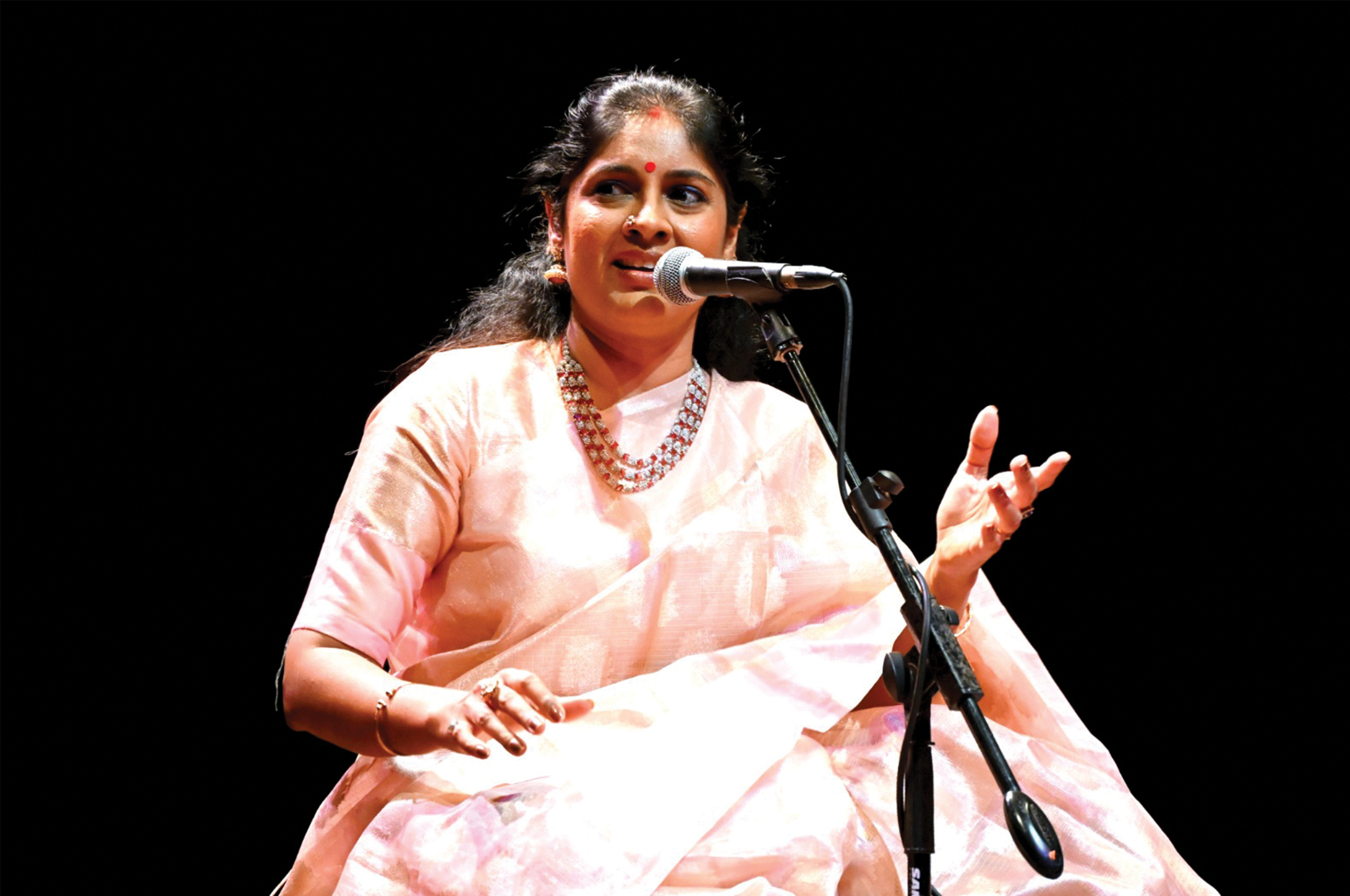
From engineer to global sensation, Charulatha Mani’s voice has lit up films, stages, and fans worldwide
An engineer turned powerhouse vocalist, Charulatha Mani has taken her music across the globe, touring London, Canada, Australia, Singapore, the United States, Sri Lanka, Europe and other countries. With numerous awards to her credit, her voice has graced hit films including Thug Life, Mahanati, Thirumanam Ennum Nikkah, Chennai Express, Maattrraan, Kaadalan Kaadali, Nandha and many more. At one of AR Rahman’s recent concerts, she sang Anju Vanna Poove with AR Rahman on the keys, that sent fans into an absolute rapture. Here’s a candid conversation with the songstress…
Your recent performance “Hamsadhwani Fusion” at Auroville beautifully blended classical ragas with contemporary textures. How did you conceptualise this fusion, and what new directions in Carnatic crossover are you exploring through it?
I’m a singer trained in classical Carnatic form of South India, but I also studied opera in Australia. My PhD was on intersections between Carnatic music and 17th century Italian opera from the Queensland Conservatorium Griffith University in Brisbane, Australia. Crossovers have been an inherent part of how I think about music for a global audience. I truly believe that Carnatic is meant for a wide audience as it has such a rich tradition in raagas. The more we go deep into raagas we understand that they are all about the emotion. Any sound texture that highlights the emotion of the raaga or the song is the one that will reach the hearts of the audience, whether they’re hearing it on their headphones or live. When I sing these songs woven with the fabric of raagas, it shows how the popular music and the music that has been there from the last thousand years or more has a lot in common with the melody and the emotion. What is music if its not healing for the heart?
You’ve submitted multiple entries for the Grammys 2026, including Livin’ My Life and Ashirvad. What inspired these works, and how do they reflect your evolution from Carnatic roots to global performance spaces?
I believe that south Asian artistes have a unique cultural understanding and location which is very strong with our roots. But with the diverse society we have access and opportunity to collaborate with various sounds and various artistes across the globe. I produced the track Livin’ My Life and its sound myself and have woven electronic textures to it to give it a contemporary feel that anyone can vibe to, without even knowing the language. It’s about a person going through life as an intense experience with all its complexities. Music should also show the verisimilitude of life – how life itself is so beautiful yet complicated like the music.
Similarly, Ashirvad is a collaboration with an Australian Chilian award-winning composer and a team of global artistes and a 10-minute-long song, which was shot across India. The composition was by Alex Pertout. I’ve sung some bold vocals from the heart as well as subtle tones in a raaga called Charukeshi. A platform like the Grammys gives us an opportunity to create work, share work and to be appreciated by our peers. To submit these works itself was an honour and as the voting member of the academy it means a lot to be able to do this every year…to take music that is born and brewed in south India, in Chennai to the world.
Carnatic music often emphasises tradition, yet your projects show bold experimentation. How do you balance respect for classical purity with the urge to innovate for modern audiences?
When you look at the history it has been evolving for the last many years. Tradition shouldn’t bind people. It should be like a flower food to bloom further. There is potentional in any art form to evolve. I feel that we can stay true to the essence of our tradition without compromising our core values. Lot of purists close doors and feel that closing them is purity. I believe in keeping all doors open, while having a total respect for the core values. That balance is where respect for tradition is. By nature I’m an experimental person and a bit of a maverick, but at the same time I also value aesthetics. It’s not that I throw in some ingredients and it becomes music, I deeply think through anything I do, whether it’s the texture or a collaboration with a particular artist. Many people have told me that I have a multi-dimensional voice. I can sing in a bold, or soft, or a husky tone and can bring emotion that is intense and passionate and also emotion that is understated and subtle.
Your signature series Isai Payanam has introduced countless listeners to the beauty of ragas across film and classical contexts. Looking back, how has this project shaped your identity as both educator and performer?
Isai Payanam has been one of the most pivotal projects, although I did it very early in my career. I was always excited about raagas in films, from Ilayaraja to AR Rahman and currently Anirudh Ravichander or Santhosh Narayanan. I’ve always seen that film music has a beautiful way or bringing raagas to a wider audience. Carnatic music cannot thrive in a vacuum or a bubble where people just go to Sabhas in December. It becomes very sporadic kind of engagement. Some of these are in small venues and not marketed or publicised well, hence the limitations of Carnatic music reaching a wider public. When you look at films, these composers have taken fragments of raagas and made beautiful melodies, with raagas at their core. One should respect both Carnatic music as well as film music and see how best both meet through a blend. When I blend raagas and Carnatic pieces with improvisations in a concert and also have a piece by ARR, the public gets a wide spectrum of what a raaga was and what it can be. I’m doing purely also for personal joy too. The fact that people are loving it too makes me doubly happy.
Playback singing has given you a wide reach across Tamil, Telugu, and Hindi cinema. How does your approach differ when singing for films compared to live Carnatic concerts?
In playback singing, the tone and the vocal texture is of paramount importance. The emotion and the lyrics of a song convey is tied to an onscreen emotion and a character living their life. When we’re singing a playback film song, we become a part of a dream and the curator of that dream is the music composer. When I sang Anju Vanna Poove for AR Rahman in Thug Life, a Mani Ratnam film, it was a powerful moment. During the recording Rahman sir was curating every bar, including the way in which the phrases should come out and the modulations. Similarly, Mani Ratnam was there giving his feel and he would tell Rahman sir and Rahman was conveying it to me. It was a big responsibility. When you rise to that moment then the exhilaration is very high. Everyone’s doing their best because we want to win as a team. Ultimately the winner has to be the song and the film.
Whereas the Carnatic music is art. In that also there’s emotion and movement, but the objective is just the music. In a way, Carnatic concerts give us that complete creative freedom. Whereas in playback singing the creative freedom depends on the collaborator. Mercifully, I have worked with people who know of me and have my seal embedded firmly. I have been lucky to have very good collaborators.
In your Grammy-nominated track Lift My Light, you’ve woven spiritual undertones into a global soundscape. Can you share the creative process behind merging such diverse influences?
I’m a spiritual person. Because my spirituality is connected to my music, a lot of the textures I weave are deep low frequency textures which I meditate to. I meditate every day and do chakra meditation too. When that happens, my mind is quiet and receptive to the music and its words. We become one with a divine feeling. Everyone is having challenges in day-to-day life and when they tune into Spotify or YouTube to listen to music, most people do it to take a break from everyday crazy existence. In Lift My Light I have sung the everyday Tryambakam, Maha Mrityunjaya Mantra and mantras for world peace. I wrote this song for peace for all and to heal the pain. I submitted for the Grammys as well.
Your collaborations often feature eclectic ensembles like violin, mridangam, tabla, and even keyboards. What excites you most about bringing these varied instruments into dialogue with your voice?
The eclectic ensembles – the kind of instruments I use excite me. The kind of works I do, I use a traditional Carnatic violin and a traditional mridangam, but I also use a keyboard, table, percussions and sometimes guitar. Its not too busy in terms of the number of instruments as that will take away the beauty of the voice, but at the same time, that sound for me should be able to blend everything. A lot of my analogies are from cooking. I like to make my curries very subtle. The ingredients could be less but the way we blend them makes the difference. The aesthetic of the performance would vary with the place. It’s not about me, it’s about the audience and one has to catch the pulse. It’s about the collective experience. AR Rahman has tapped the emotions in my voice. I’m a woman who’s singing her heart out with all the textures in all its rawness.
As someone who bridges Indian classical traditions with international recognition, what do you see as the biggest challenge for Indian artists entering global award platforms like the Grammys?
There’s a huge burgeoning of Indie music and Indian artistes and big artistes creating non film music. Global sounds are now being presented to the Grammy’s across categories like electronic, pop and a global performance. Indian music is in a fine place where we have access to all the tools in the world to create magic.
One of the biggest challenges is to understand what global fame is all about. The reach of Sabrina Carpenter or Billie Eilish support system is on a different level. When you’re competing with people of that caliber with that kind of PR machinery it’s a different game altogether. I’m not in the music business world so I guess it’s a good thing in a way. When you start confronting numbers, somewhere the art suffers. Indian artistes are still breaking some of those initial barriers to make it big with a big audience. Biggest audience who have a chance to make it global are in Mumbai. Chennai is catching up, but we feel the gaze is still on Mumbai and Bollywood and on some well-known names like Badshah or Karan Aujla. I can’t think of too many artists from South India who have broken that level of reach. Maybe big music labels are only now seeing the talent down south. One singer who has done well from the south is Sai Abhyankar and of course Anirudh. We also have Think Music. It’s a movement…a team of people that make things happen.
AR Rahman is a trailblazer in all this…on how one can break all the shackles and go ahead with pure hard work. The biggest music icon on the world stage is from the south and a Tamilian from Chennai. As a Tamil girl I feel so proud that I’ve worked with the person who has broken all these barriers and gone straight to the world stage of Oscars.
You’ve built a strong digital presence with your YouTube channel and live-streamed concerts. How do you view the role of digital platforms in sustaining classical music for younger audiences?
A lot of artistes are now producing their own content. Anirudh has now founded his own record label. Universal Music India has partnered with Anirudh Ravichander for Albuquerque Records. Similarly, AR Ameen, son of Oscar-winning composer AR Rahman, has launched a new music label named Rooh Records alongwith AR Rahman sir. The power has gone back into the hands of the artistes. I’ve been doing that for a while now. It feels good to create work, to put it out there and for people to listen and appreciate. This is a welcome change. That is the role of streaming. Now we can distribute through a lot of platforms and try and see how the genre can fit into the lives of people. Digital platforms help in aligning people with the songs.
Tell us about your recent concert with AR Rahman in Chennai?
It was an eclectic night with 50,000 fans. I’m so blessed that I was invited by Rahman to present a very interpretive new version of our song. We cooked a new version and served it and we are so happy that it was received so well. To sing in his presence, while I was singing with him on the keyboards and conducting various instruments, was so surreal. When I presented the fusion piece, Chennai could witness sargam patterns with swaras. It was structured and yet so organic. Only a person like Rahman sir can think of that blend. He curated that entire process and I was blessed to be a part of that night. Shalini Ajith Kumar met me later and told me how much she loved my song.
Looking ahead, what upcoming projects or collaborations are you most excited about in 2026, and how do they continue your journey of blending heritage with innovation?
There’s a lot going on. I’m doing my Indie songs, singing for major film projects, a lot of film producers and production companies, live shows performing across India and internationally, creating fusion filmi raagas and so much more.