

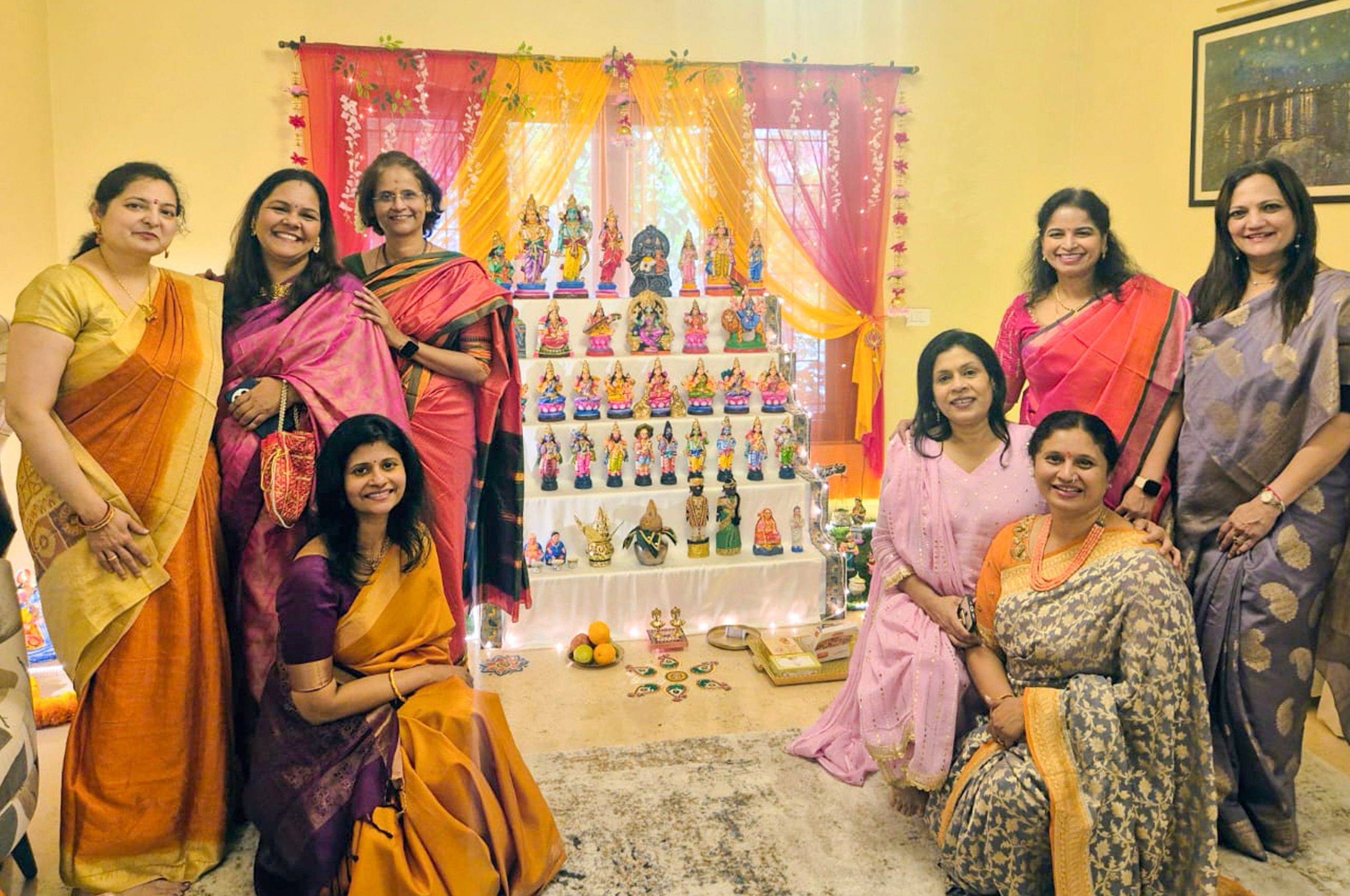
During Navaratri, families across parts of South India find renewed spirit to create a bustling home. Furniture is moved aside, steps are assembled and covered with shimmering cloth, lamps are lit, and boxes that are nowhere to be found for the remainder of the year are suddenly reopened. From them emerge gods and goddesses, kings and queens, musicians, animals, villagers, wedding parties and miniature scenes of everyday life. For nine nights, these inanimate figures inhabit the home as something more than dolls. Something that most definitely carries soul.
This practice is called Golu, Bommala Koluvu or Gombe Habba, a tradition of arranging models or figurines during Navaratri that brings together devotion and community. The familiar five, seven, or nine-stepped display is only part of it. A Golu can unfold into a miniature universe, where episodes from the Puranas coexist with scenes out of ordinary life, where an old family doll, preserved through generations, sits just as pristinely beside something newly bought, and where the sacred exists alongside the playful.
Its history, too, is enchanting. Scholars have found echoes of the grand Navaratri celebrations in Southern India’s royal courts, particularly the ceremonial traditions of Vijayanagara, in the way the practice takes shape in domestic spaces. In households, somewhere along the way, it has become the organiser’s intimate form of storytelling, where history, mythology, folklore and all other kinds of stories could share a stage with music, prayer, prasadam and the imaginations and sentiments of its creator. That brought about a tradition that isn’t linear. Its stories may be ancient, but the tradition will remain ever evolving.
I have come to think of this continuity through R Suresh’s Golu, which I have looked forward to seeing for years. Entering his home during Navaratri doesn’t just feel like arriving at a display or stopping in front of nine steps. The Golu unfolds through the house, drawing you from one scene to another, each space revealing a side-track story within the main story, another character, another small detail that you are bound to miss if you only took a light stroll around.
His relationship with the tradition began early in his childhood. His father started their family Golu, creating parks and elaborate arrangements, and Chennai-based Suresh grew up fascinated by it and by the grand Golus of family friends. Around 45 years ago, when he was around 20 years old, he began creating mythology-themed Golus himself. Over time, his interests in Tanjore painting, classical instruments, music, dance, mythology and his own engineering background began finding their way into the display.
That evolution is also visible in the stories he chooses to tell. Nava Vida Bhakti, Amukta Malyada, Sri Krishna Tulabharam, Amrutha Mathanam, the Mathura Puri Yatra of Sri Krishna, Padmavathi Parinayam, Ramayanam, Maya Bazaar and Rasa Kreeda have all found expression in his Golus. There have also been dance scenes from Chandralekha and Salangai Oli, and a Sri Badri Kshetra theme based largely on the Srimad Bhagavatam. Sometimes inspiration comes from cinema, and a familiar scene is retained while its central character becomes Sri Krishna. For Suresh, there is a thread connecting these varied worlds: “For me, Bhakti Rasa is the Sutra.”
The making of these worlds is as much a part of the tradition as the stories themselves. Barbie dolls become the characters he needs. Their hair is altered, their original clothes replaced, and jewellery, costumes, hairdos and all other paraphernalia are made by hand. One of his favourite dolls, created as a Kuchipudi dancer for his Krishna Tulabharam theme and inspired by Bhama Kalapam, wears a Nakshatra
Jada, with a parrot on her head, a Naga and other intricate details. Though his collection has nearly reached its threshold, he still adds around five dolls every year.
Then again, quite naturally for an engineer, came technology. In 2020, during the pandemic, Suresh introduced Alexa, smart plugs and automated elements, with help from his second son, allowing stories to unfold through sound and movement as visitors entered the themed rooms. Although this was initially an attempt to create a hands-free, or rather contact-free Golu showcase for his guests, it remained throughout the years because technology offered another layer to his storytelling. Visuals, colour, sound and movement could now work together.
Suresh is not the only one who has found a personal language within Golu. For Jayshree Ramaiyer, the tradition began with the birth of her daughters Prithika and Ankitha two decades ago. Then, she was living in the USA. Her mother-in-law had kept Golu, and with time, what began as a connection to that tradition became a creative practice of her own. Initially, there was a lack of resources in terms of Golus where she resided. However, she consciously collected and transported dolls from back home through her mother or while she travelled. Over time, thanks to Garuda Seva and other means, Golu shopping became relatively easier, allowing her to sit with her creative ideas to create more compelling narrations.
Her Golus were made with children in mind: a farm with paddy fields, an entire Ramayana built piece by piece over nearly two decades, a Navagraha temple, musical instruments, and even a school recreated from cardboard when her daughters were at NPS in Bangalore. Jayshree enjoyed creating these stories. She even recalls instances when she was out shopping and turned to every interesting article, wondering where to fit it in her grand displays. This passion shows in her patient collection of dolls for about 18 years to create a complete Ramayana set.
Her goal was always to make familiar tales tangible and interesting enough for youngsters to enter them. What began as seven hand-built, Home Depot steps eventually became a gathering of nearly 120 women, complete with tambulam, decorations and even an Elai Sappaadu for nine of her closest friends. For her, welcoming each woman is also an act of devotion, receiving their presence as the blessings of Goddess Lakshmi. “It is all very intentional,” she says, and maybe that is what sits quietly beneath both these Golus: the act of creating is itself an offering.
Another Tamilian living in Bangalore is Sumithra Sivaramakrishnan, AVP at LTM. “Sometimes, a tradition you grow up around becomes a tradition you eventually make your own. Growing up in Chennai, Golu was always a familiar part of our community. I used to think it was a lot of work and needed so much creativity! During Covid, I finally decided to give it a try to brighten the mood and bring a few friends together. Little did I know that it would become an annual tradition and a much-awaited event of the year for all of us! Golu is really storytelling through dolls. The traditional Golu setup already has a story for each step — whether it’s the Ashtalakshmis celebrating the many facets of women, the Dasavataram sparking children’s curiosity about the avatars, or a park scene reminding us to appreciate the beauty around us. I also enjoy creating themes — from Mysore Palace and Vrindavan Gardens to Krishna Leela. It’s my way of bringing tradition, storytelling and a little bit of fun together. Golu is all about stories and visual elements. One of my favourites is Krishna Leela, bringing alive stories like Krishna and Sudama and the timeless value of friendship. I also love adding fun touches like wedding scenes and food stalls that the kids enjoy,” shares Sumithra.
“But none of them would come alive without my friends. I truly see Golu as a community project — a labour of love that we create together. I’m blessed with incredibly creative friends who bring their ideas, time and talent, and I lean on them for everything from décor to props. A big thank you to Saumya, Shilpy and Dayanand for helping me bring the Golu alive, year after year! And of course, my husband Sundaram is a big part of the Golu journey and my partner in everything — from the setup and lights to the food and everything in between. I’m truly grateful to all my friends and family who visit, celebrate with us, and make Golu so special every year,” adds Sumithra.
Perhaps these are the things that make Golus so wonderful, so enduring. It lives because people continue to place their own imagination beside what they have inherited. Somewhere between the dolls passed down by a grandmother, the stories remembered from the Puranas, a handmade costume, a Barbie turned into an actor and an Alexa handling lights and sound, tradition becomes something wonderfully alive.
Every year, the boxes open again. The stories return. And someone, somewhere, finds a new way to tell them.