

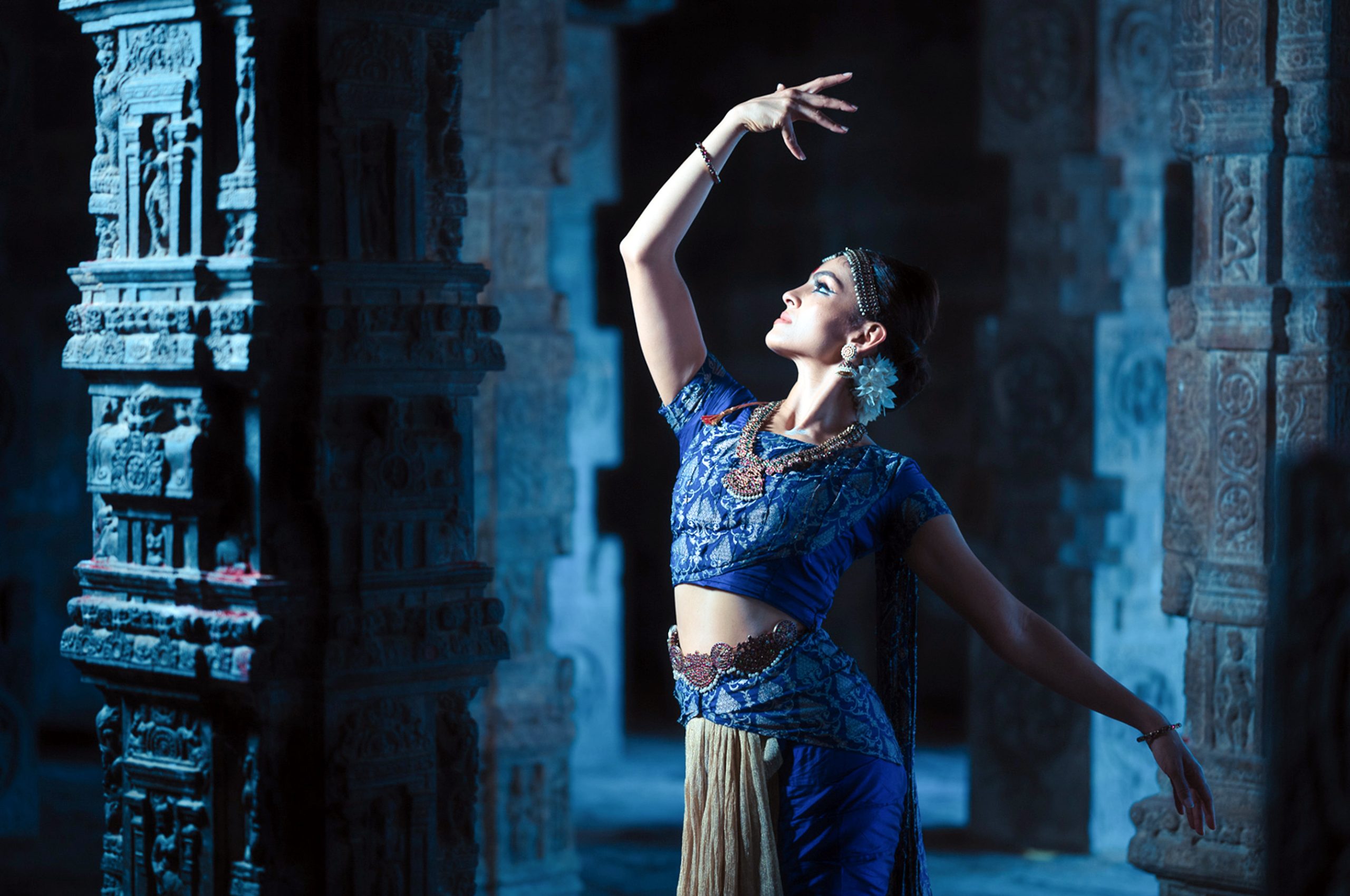
Rukmini Vijayakumar, Artistic Director of the Radha Kalpa Dance Company and Director of LshVa, a creative space for artists in the heart of Bangalore, lit up the stage at the Provoke Art Festival 2025. Founder of the Raadha Kalpa Method, an educational system for Bharatanatyam, she brings new dimensions to the dance form, enhancing its relevance in both traditional and modern contexts.
She studied Bharatanatyam under Guru Padmini Rao, Guru Sundari Santanam, and Guru Narmada. A graduate of the Boston Conservatory, she is also a recipient of the Jiri Kylian Grant for Choreography in 2018, Gandharva award by Madhya Pradesh in 2021 and has created and premiered two works, Unrequited and The Muse, at the Korzo Theatre, Netherlands. Her productions Nayani, Prabhavati, Talattu, The Dark Lord, and Ishwara have toured India and the world extensively. Also, an actor, Rukmini has been recognised for the roles that she has played in a number of Indian films and theatre performances. Her book ‘Finding Shiva’ was selected to the IAAC Literary Festival in 2022 in New York City.
What first drew you to dance as a form, and how has your relationship with the Bharatnatyam evolved over time? When did you start your training and decide to take it up professionally?
I always loved dancing from when I was a child and began dancing Bharatanatyam because I used to watch my mother go to Bharatanatyam class. That was when I was five years old and over time, I started enjoying the form because of its nuance and its connection to the spiritual roots and the fact that it’s such an integral part of Indian tradition. I come from a very traditional family, so it just worked for me and I started training when I was five years old and soon decided to take it up full time after high school.
You’ve trained in both classical and contemporary styles. How do you combine the best of both these worlds into your choreography?
I’ve trained in Bharatanatyam, yes, and also contemporary styles. I went to college for ballet and modern dance. In college it was just basically ballet and modern training and within the scope of modern, my school was slightly more old school so we were doing mostly these classical, first-generation modern technique styles which were the Paul Taylor, Graham, Horton, and Limón and later there were a lot of other neo-modern or post-modern schools of thought which were quite different than my training. Bharatanatyam is my main form and the form that I think with, breathe with, move with and any other art form movement I learn somehow just informs my body to be more open. From contemporary schools I learnt the idea of momentum, from ballet I learnt about muscular progression, so a lot of the other forms have taught me to see space differently, see choreography differently but it’s not a literal vocabulary that gets put in or merged together in my choreography.
Tell us about the piece you performed at the Provoke Art Fest?
At the Provoke festival, I performed a collection of pieces that were on Krishna. And the first piece was based on Andal or Nachiyar. And she’s written these verses called the Nachiyar Thirumozhi, where she imagines the Lord Krishna as her consort and she imagines being wedded to him. So, I took this traditional Kautvam format and some of the verses from the Nachiyar Thirumozhi and put them together to bring out the idea of this devotion of Andal.
The next piece that I performed was a Varnam, which was a very well-known Varnam in Raga Charukeshi by Lalgudi Jayaraman, the composition. Here, I interpreted it from the perspective of a Gopika who was in love with Krishna from the first time that she saw him. She says, how can you be indifferent to my love for you? Although it starts out a bit more on romantic lines it progresses through the Varnam. And by the end, sorry, although it starts off a bit romantic, progressing to self-unfoldment. In the second half, she basically says that Krishna is the one who plays the flute and He is in everything she sees. So, this yearning that is in the beginning of the Varnam, becomes no longer relevant because she finds him all around.
Can you walk us through your creative process, from concept to stage? How do you approach abhinaya differently when performing for live audiences versus digital platforms?
Concept to stage is very different for traditional work and different for open-ended conceptual work. So, both follow a completely different process. If it’s traditional work like what I performed at the Provoke Festival, I usually find a composition, I will analyse the composition, understand the lyrics, understand the nuance of the lyrics, the thalam, and then I’ll work on choreographing the jathis. However, in abstract or more conceptual or slightly more contemporary pieces, I take a lot more time because it takes a while to write and read literature, write down my thoughts, sometimes it’s a physical inspiration, sometimes it’s emotional, or social, cultural, literature, as inspiration can come from anywhere, and once I have it collected, then I begin on the structuring process for a performance. And the last comes the movement. There’s a movement experimentation stage, then I’ll get musicians and dancers involved, and the lighting designer involved, and then it all comes on the stage.
You’ve performed across the world. How do international audiences respond to Bharatanatyam? Which have been some of your most memorable performances?
The traditional work reaches some people and sometimes the more interpretive, abstract work reaches some people. A lot more people are more open to Indian traditional dance as well as the contemporary work that is coming out of these vocabularies. Art crosses borders in the most inexplicable ways. I will always remember the work I created while being in this theatre group in the Netherlands. That process of creating it was very memorable for me.
How do you stay creatively inspired? Tell us about your travels and your other passions too.
My travels are all for dance. I’ve not gone on a holiday in a very long time. Everything’s mainly been for dance. I’ve been doing a lot with wellness retreats too, so it’s either for dance or for wellness. Everything feeds into this movement personality of mine, whether it’s free diving or running or whatever, all of it is related to movement and exercise and this wholesome living which dance has taught me. I always have thoughts of new things and what to make. It’s not an inspiration that comes from outside rather it’s something that’s just there inside me that needs to keep speaking and that speaking happens through dance.
What’s a dream project you haven’t done yet?
There’s one of an immersive dance show that I’ve been visualising for a long time. I’ve also been thinking of acting in a film that’s really challenging for me. Nothing is tangible at this moment, but it’s a feeling that I have for now.
What legacy do you hope to leave behind in the world of dance?
A legacy of joy and contentment.