

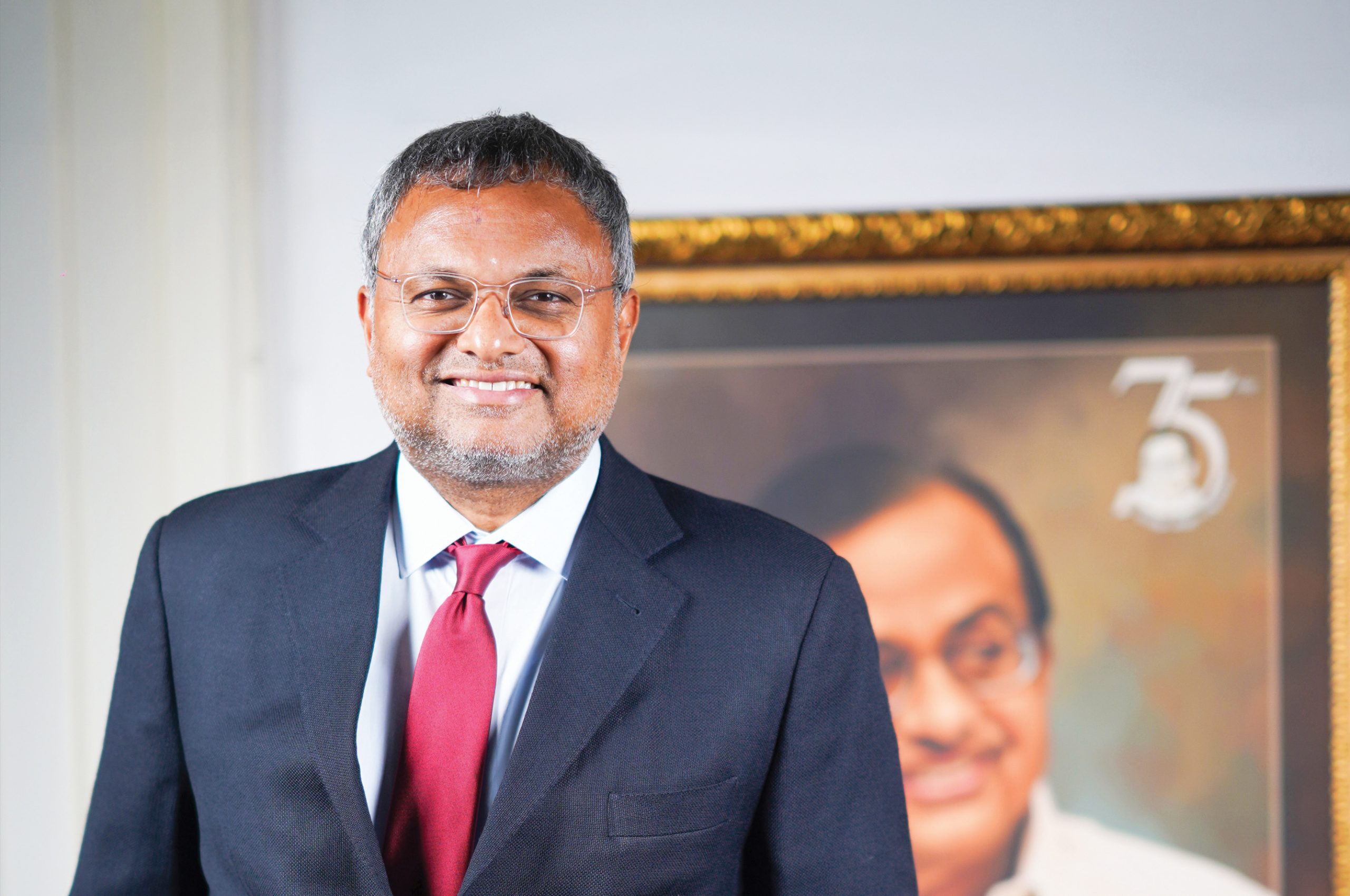
Son of former veteran Finance Minister P. Chidambaram, Karti Chidambaram has carved out a persona that stretches well beyond the political arena. Tennis remains his first love. Once a competitive player, now a committed administrator shaping the sport’s future in Tamil Nadu and abroad, his calendar may be filled with parliamentary duties, but his heart finds balance in walking through European streets, tasting local cuisines, and catching live matches at Wimbledon or Roland Garros. A self-confessed foodie and avid traveller, he journeys across continents over ten times a year, weaving together politics, sport, and culture into a life that is as cosmopolitan as it is grounded. Here’s a candid chat with the dynamic Karti himself.
How was it growing up in a political household? Was there any pressure to follow your dad’s footsteps or was it like a natural choice to get into politics?
I always wanted to be in politics. I grew up in an environment which was very political and surrounded by a lot of political personalities. My father was in politics even before I was born, and my mother, would actually bring the newspapers to me and keep me updated on all the national and international affairs. So, politics was around me all the time. This year, 2026, marks my 30 years since I got into active politics. It was a voluntary decision and not something that anybody expected from me. Since my dad was in politics, it just came naturally to me.
What have been the important life lessons you learned from your dad as a father?
He is a very different personality, but of course he’s very popular and a huge public personality. Growing up with somebody who is a big public personality, is likely different from somebody who doesn’t have a public persona. People judge you a lot because of whose son you are. It’s a bit unfair, but there are many advantages also. So, I try and see only the advantages over the disadvantages and stay away from unfair criticism. I’m so glad that I’m able to work with him closely. Not many people with political careers are contemporaries with their fathers or parent. They’re usually in power after their time. I’ve being fortunate enough to be in politics at the same time as he is and also be in Parliament at the same time, which is not very common.
Any defining moments if you can recall… some of the highpoints of your journey so far?
Politically, the most exciting time, was in 1996 when I got into politics. The formation of the Tamil Maanila Congress was a very exciting time for me. I saw the middle class coming out and voting and also joining the party for the first time. I’ve never seen that kind of enthusiasm for any new political party in Tamil Nadu. But we didn’t capitalise on it. The whole process of breaking away, forming a new party, getting a symbol and contesting election was a very exciting time for me. It was shortly after I came back from England after my education and got initiated into it right away. Obviously, winning elections has been very pleasant. I won elections twice and have contested three elections. I’ve also been involved in every election since 1996, be it Parliament or Assembly. I like the idea of campaigns and elections and winning makes it worthwhile. But, on the other hand, sometimes politics can also can be frustrating. You want to do so many things, but the way our system is structured, our executive authorities with the government legislatures, and how the government is aligned with us matters on how we can get things done when. Even the whole process of delivery mechanism is very slow. I’m not a big fan of large and very grand government schemes, because they really don’t reach the right beneficiaries.
I believe in much more direct and local action. It’s also good that you can actually see how you’re making a difference in people’s lives and helping them. For instance, help someone get a student loan or get someone one of the schemes that are stuck somewhere is very satisfying. But again, it’s also frustrating because the pace in which our country works is slow. The Congress party has had its ups and downs, but that’s the party which I am most comfortable with. No other political party will tolerate somebody like me who’s as free spirited and vocal about the pressing issues. Congress can do a lot more than they’re doing right now.
What are the three urgent pressing issues facing Tamil Nadu and how do you hope to address those?
The biggest issue for all India is employment in my opinion. That is the biggest elephant in the room. Young people coming into the job market don’t have jobs. We are training people, we are educating people, but that education is not necessarily what the market wants. There is a gap in the market, but we’re not training people for that. Any government must look at employment generation. But government itself can’t create employment. They must create an environment where private enterprises can create employment. We must tune our education system to what the market wants. For example, the construction industry needs so many skilled people, but we don’t have that kind of skilled staff. We are still very rudimentary in our schooling.
One should look at employment generation sector by sector, look at what the needs are, and give those kinds of training. The central government has come out with lots of schemes on vocational training and I know that none of them work here in our system. Apparently, 48,000 crores of schemes have been announced that have been merely on paper. A lot of these schemes never really translate completely to the people of India. The second thing is ease of living. The average person in this country struggles everyday, be it housing, transport, access to electricity at reasonable price, water, quality roads, access to schools, hospitals, all those things are pain points and we must try to reduce the pain points for people.
Indian politics often struggles to attract young talent. How do you plan to inspire people to come into politics?
That’s not true anymore. If you look at the average age of many assemblies and many parliaments, younger people are entering politics. I’m in my 50s now, so I’m not young anymore, but when I entered politics, I was young. Even if you do a rudimentary check on the age of people in Parliament or constituency, you will realise that many young people are coming in.
The old are getting replaced by young. That’s the natural process that’s happening across India.
Outside of politics, what are your other passions?
Tennis is my number one passion. I follow it very closely and I have been associated with it. I don’t play much now, but I used to play competitively. I’m quite involved in the administration of tennis in Tamil Nadu. I’m also involved in the development activities of tennis even in the international world. I also like to travel and I like to eat well. I’m a big foodie. I like to try and eat local food whenever I travel. Whenever I get time from the daily demands of Indian politics, I like to walk, eat good food, meet friends, play tennis and also watch tennis.
What are some of your favourite travel destinations?
I have been travelling for many years now. I also have some business interests outside India, so I’ve been travelling ever so often. I’m out of the country at least eight to ten times a year. So, I finish my work and then I take out time to explore. I love to visit Europe, England, France, Spain, Germany, Vienna, Austria and other countries. I go to Spain, France, and England quite often. I walk a lot whenever I’m travelling. I also try and go to watch a lot of tennis matches live whenever I’m travelling.
What kind of books do you read and what kind of films do you like to watch?
I like to read a lot of inspirational biographies. I don’t sleep very well on planes, so I used to read books. My reading has come down a bit, but I still tend to read digitally. I should go back to reading physical news, articles and also physical books like I used to earlier. Now, I download movies on Apple TV and watch interesting series and movies on Netflix, whenever I can find the time. I also watch a lot of documentaries.
Any role models in sports or tennis?
My hero in tennis is the American tennis legend John McEnroe. I used to admire him on TV and I started playing tennis after seeing him play in the 1980s. I like a few other tennis players too and watch their matches.
What about other sports?
I also play cricket. I watch a lot of sports.
You’ve also shown interest in technologies, startups, and global engagement and what do you think are the opportunities in these fields?
Technology is definitely a big game changer. But the point is, are we training people adequately to deal with the changing technology? AI will replace a lot of things, but when we talk in slogans about yes, we will train people in AI, I always wonder who’s going to train them? They say we have enough trainers. Every time we say, we’re going to impart a skill, do we have the personnel to impart those skills? Are we training those people who are going to be the trainers? What is the curriculum going to be? There’s a huge gap in what we’re doing. A lot of technological innovations will come about and I’m afraid a lot of people will not be able to adapt to it, because nobody’s training them and because we don’t have the right faculty to train. Nobody asks those questions. Nobody ever asked a question, is our curriculum up to
Politics can be very intense and all consuming. How do you switch off and find your balance?
There’s lot of work in politics, but as public representatives we are also expected to be at many public events. They may not be just political events, but because of the nature of our political structure, we have to be present even for many social events. It could be for social causes, festivals, colleges, other functions etc, the list is endless. You need to have a great capacity of physical stamina to do all this. Everybody outside thinks that politicians lead a very glamorous life, but if you come and see our schedules, you’ll realise how punishing our schedules are and how much time consuming they are. You really don’t have any me-time. You have to struggle to find your own downtime. In India, particularly there are no boundaries, There are no weekends. At any particular time of the day, there are demands that we need to fulfil. That’s the nature of our society.
So, is there like a day you decide to switch off and tell yourself today I will relax?
I can’t switch off. People might have a genuine emergency and may want to reach out to you. They reach out to me all the time. But during the day, you just try to snatch some time for yourself and balance it all and then you’re back with all the action.
Where did you spend your growing up days?
I grew up in Chennai. I went to school in Madras and went for my undergrad to the United States. Then I did my law degree from the University of Cambridge in the United Kingdom. So, I spent many years outside India.
Did you practice law?
No, I didn’t practice law. I studied law only to please my parents.
What are the most memorable memories you have from your childhood?
I enjoyed school. School was very glorious for me. I did multiple things in school. I was good in debates, I was good in elocution and quiz, I swam and played tennis, I ran and I also played cricket.
Are you in touch with your school friends?
Yes, I am. My school batch is well connected. We meet once a year for a reunion. And I also have some close friends within my batch.
What gives you the greatest pleasure when you come back home?
To play with my dogs.
What are their names?
Here in Karaikudi, I have one pet dog named Giri and in Madras I have two pet dogs named Daisy and Becky.
How do you balance your public life with your personal life?
There’s no personal life. Everyone follows you. Every person plays multiple roles of family, business, profession etc. You also must be playing many roles.
Are you the kind of person who has plans for the next five years or do you like short term plans?
I have a few ambitions and goals for which I like to plan, but my schedule for the upcoming weeks are always planned and organised. That’s the only way to work. Even my travels have to be planned a little in advance.
When you meet regular citizens what is it that you give them or sometimes even learn from them and adapt to their requests?
The first and most important thing is that one must be a good listener. What people say might be trivial to you, but it matters a lot. One must listen to them with respect. More than a good speaker, the first trait for a good politician, is to be a good listener. And everybody has got issues, and the reason they come to you is because the system is inefficient. A system is efficient they need not come to you. There must be something lacking in the system that’s why they come to you for your intervention to set things right and one must be empathetic towards them.
What role do art, culture and heritage play for you?
I like designs that are minimalistic and I like to admire good architecture. Chettinad has got a lot of potential and should be a UNESCO heritage site. It has a great potential in terms of historic temples, heritage architecture and great food. It attracts the entire world. There’s still lots more that can be done.
Tell us about your beautiful family.
I have a small family. I’m the only child and am married to the only child of her parents. And we both have one child.
How old is your daughter?
My daughter’s 24, currently doing her PhD in Oxford University in educational policy. She did her Masters at Cambridge. She wants to be a policy maker.
What does your wife do and does she accompany you on your travels?
My wife is a doctor and is very supportive. She doesn’t travel with me much. They like to travel and be in a place for a long time. They don’t like the way I travel because mine is quite hectic. I have to keep hopping places.
What are your future plans?
To continue serving the people in politics. I just want the Congress Party to strengthen itself in Tamil Nadu and become more relevant. That is what I would like to see in. The space is getting crowded in Tamil Nadu. I’m also a sportsman and have a couple of small companies.
Rapid Fire
Tea or coffee?
South Indian strong filter coffee, with milk and no sugar.
Your favourite author?
John Grisham.
Favourite sport?
Tennis.
One word that best describes you in and outside of politics?
Free spirit.
Beaches or mountains?
Both.
kurtas or denims or casuals?
Most of the times I’m only wearing a veshti and shirt. I like to dress according to the weather so this is what is suitable for Tamil Nadu.
Favourite film?
I like good movies. I don’t watch Hindi movies. It’s mostly English movies that I watch now. I used to watch a lot of Tamil films earlier, but I’m not really very happy with the movies these days. The earlier ones were better.
Your favourite actor?
Kamal Haasan.
Any comedian that you like?
Nagesh.