

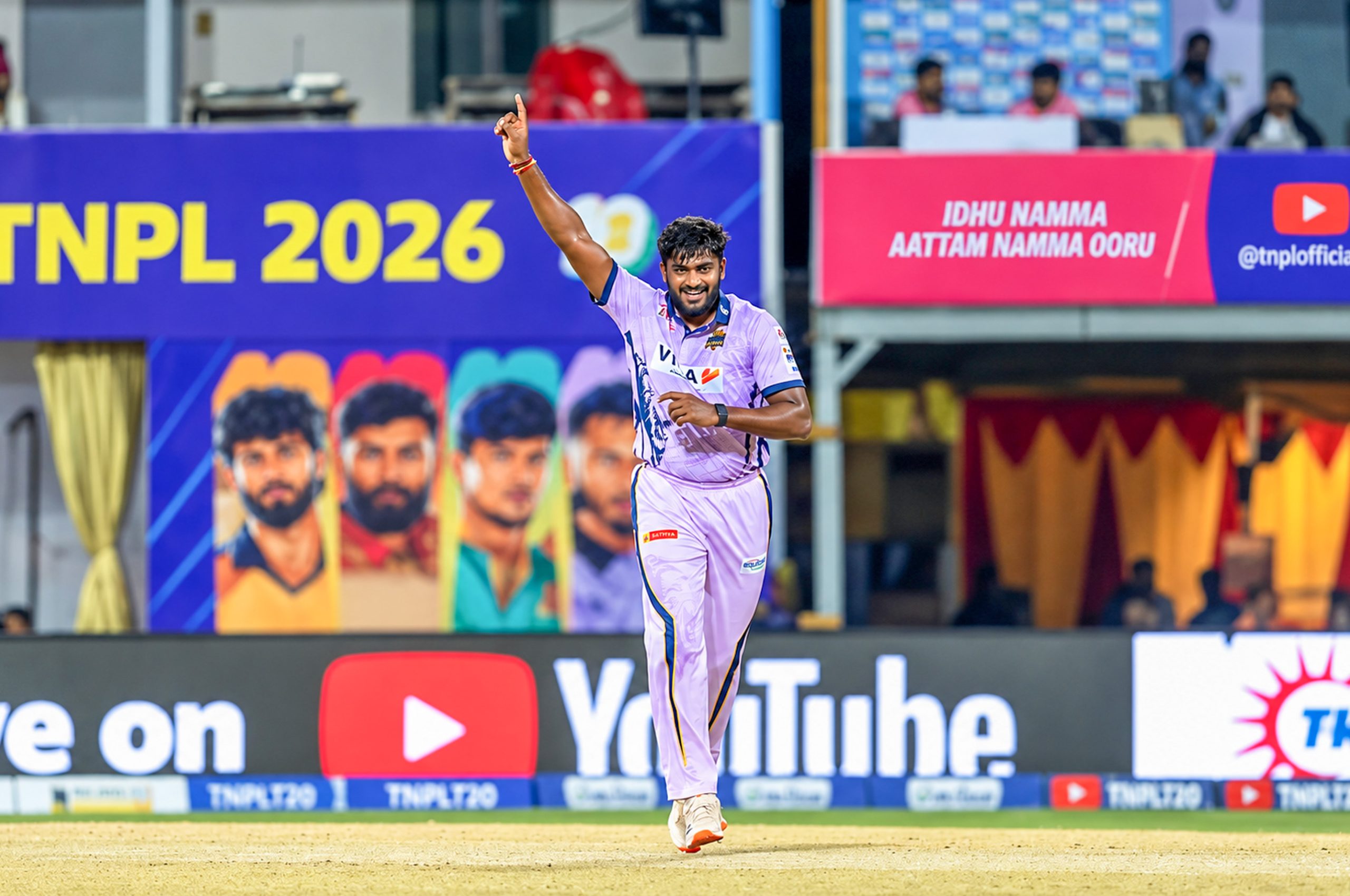
Defending a target in a high-stakes knockout match is all about pressure. For Deeban, it lasted exactly three balls.
Steaming in for the first delivery of the innings against the Trichy Grand Cholas in Qualifier 2, the Kovai Kings pacer pitched it wide outside off and induced a desperate poke, with the wicketkeeper completing the catch behind the stumps. The next ball was similar, only a fraction closer to the batter. Another edge flew towards first slip.
Two balls. Two wickets. With a hat-trick in sight, Deeban went over the wicket to the incoming right-hander. He produced a vicious in-swinger that beat the bat, slipped through the gate and crashed into the stumps.
Three balls. Three wickets. Three golden ducks.
It was not merely a dream spell. It was the first opening-over golden hat-trick in TNPL history. And for Deeban, it was the most spectacular moment of a season that had already represented something far more significant: his return to cricket after two years away.
The 26-year-old had spent those two seasons battling injuries and watching opportunities pass him by. When he finally got his chance again, he did not merely return to the competition. He finished the tournament as its highest wicket-taker and was named the Most Dependable Player.
The three balls in Qualifier 2 were the perfect punctuation mark to a comeback that had taken years to build. But Deeban’s journey began much earlier, in Hosur. Cricket was not initially a career he had mapped out for himself. It was his father who first saw the possibility.
Growing up in Hosur, Deeban would travel to Chennai when the Tamil Nadu Cricket Association conducted its summer camps. The camps lasted about a month, because that was when coaches were available. During one of those camps, coach Sivaprakash identified something in the young cricketer. “He has the talent in him,” was the assessment. It was not an isolated opinion. Coach after coach returned from the summer camps with similar feedback. Deeban was doing well. He had something worth developing.
His father listened. “He told my mother that we are going to make him train in cricket. Let’s not make him focus much on studies; let’s see to it.” His mother and sister supported the decision. Deeban did not have to convince his family of the path he wanted to take. They understood what he was trying to build.
His father’s interest gradually became his own. “Slowly, his interest turned into my interest,” he says.
The family then went a step further. The monthly camps were not enough for a young cricketer who needed to practise every day, so Deeban’s father and his friend’s father-built practice nets near their homes. After school, the two boys would practise together. They eventually brought in coach Bernaud, along with two others, and the group of five trained daily.
The environment allowed Deeban to develop both sides of his game. From childhood, coaches had encouraged him to focus equally on batting and bowling because they saw ability in both.
His father even had a particular all-rounder in mind. “He used to tell me I should become like Kallis.” Jacques Kallis became Deeban’s childhood inspiration. The South African’s ability to influence games with both bat and ball represented the kind of cricketer he wanted to become. In more recent years, Ben Stokes has become another reference point.
But while the dream grew, so did the interruptions. Deeban suffered his first major injury at 16, while representing Tamil Nadu Under-16s. It kept him out for eight months. More injuries followed throughout his career, repeatedly disrupting his progress.
He missed opportunities, including South Zone camps. Even before the most recent two-year absence, injuries had repeatedly taken opportunities away from him. “I had lost a lot of opportunities because of injuries,” he says. Initially, the setbacks affected him mentally. But Deeban had people around him who refused to let the injuries become the end of the story.
Trainer Dinesh became more than someone overseeing his physical preparation and rehabilitation. Deeban describes him as a brother, someone with whom he could speak about anything.
His mentor, Selva Ganapathy, played a different but equally important role when Deeban found himself at his lowest mentally. He reminded him to be patient, wait for the opportunities and keep going.
His family did the same. When performances were not coming and things were not going his way, they did not pile on the pressure. “They didn’t ask me anything. They were really supportive.” That support became particularly important during the two years away from the game. Deeban could not control when the next opportunity would come, but he could control what he did while waiting for it.
He worked on his bowling, concentrating on his line and length. He trained. He rehabilitated. And he learned patience. “Injuries are very common in cricket. It keeps knocking the door. It’s all about how we bounce back.”
When the opportunity eventually arrived, it came through Kovai Kings captain Shahrukh Khan and coach Thiru. Deeban had played in the TNPL before, but he had never received an opportunity quite like this one. This time, someone trusted him with responsibility, and he repaid that trust with wickets.
The numbers tell part of the story: highest wicket-taker and Most Dependable Player. But Deeban is more interested in what those numbers meant for the team. “I am happy that my contribution played a role in the team’s success.” The biggest change, however, may have happened inside his head.
Years of cricket had taught Deeban that pressure can become its own obstacle. He had learned from his trainer, mentor, family and coaches that the game had to be enjoyed. “If we enjoy something, we’ll automatically put effort. We’ll spend a lot of time in it.”
It sounds simple, but for a player whose career had repeatedly been interrupted, it carried weight. He realised that constantly pressurising himself to perform could become counterproductive. Cricket changes, players change, and no one can expect to perform exactly the same way a decade later.
So rather than obsessing over what the next opportunity might bring, Deeban focused on enjoying the work in front of him.
That mindset seems to have served him well.
Now, after a season that has restored momentum to his career, his ambitions are straightforward. He wants to play senior cricket for Tamil Nadu across all three formats: the Ranji Trophy, Syed Mushtaq Ali Trophy and Vijay Hazare Trophy.
India remains the dream too, although Deeban is careful not to claim a place before earning it.
“I am not sure about filling the vacuum,” he says of India’s search for a dependable medium-pace bowling all-rounder. “But everyone has the dream to play for India.” He knows what it will require: more hard work, greater consistency and the willingness to keep doing the unglamorous things.
That is also his message to younger cricketers coming from small towns. The opportunities, he believes, are no longer as scarce as they once were. But the competition has become relentless. A couple of poor games can be enough for another player to take your place.
Fitness matters. Hard work matters. But consistency matters most. And patience matters too. “You need to keep doing the boring things and grab the opportunity when it reaches you.”
For Deeban, that opportunity took years to arrive. He worked for ten years, endured injuries, missed camps, spent two seasons away from the game and reached points where he considered giving cricket up. Yet he stayed.
His life away from cricket is almost comically simple. Train in the morning. Eat. Sometimes cook for his parents, both of whom work. Go to the gym in the evening. Practice again. Meditate. Watch movies. Sleep. Repeat. He calls it boring. Even his preferred outfit is uncomplicated: shorts and a T-shirt, much to the annoyance of the “special person” in his life who keeps telling him he wears shorts too often.
But perhaps there is something fitting about the simplicity. Deeban’s comeback was not built in one spectacular moment. It was built in the boring hours: the training, rehabilitation, repetition and patience that nobody sees. Then came those three balls in Qualifier 2. Three wickets. Three golden ducks. A place in TNPL history.
Deeban says that five years from now, if people remember anything about him, he wants them to remember those three deliveries. If he eventually plays for Tamil Nadu and India, he wants to be remembered as the small-town boy who worked his way there.
More than anything, he wants to be remembered as someone who enjoyed cricket. “He enjoyed cricket and it gave him everything.” For two years, Deeban had been away from the game. When cricket finally gave him another chance, he made sure he was ready.