

I’ve filed dispatches from tech conferences across three continents — from CES floors thick with vaporware to Bengaluru’s startup corridors buzzing with genuine disruption. But the first week of June 2026 in London was categorically different. This wasn’t a convergence by design. It was one by consequence — three of the industry’s most consequential events running simultaneously in the same city, each pulling in a different direction, yet all arriving at the same unavoidable conclusion: the AI era isn’t approaching. It has already arrived, and the world’s most powerful technology companies are now laying its physical, commercial, and legislative foundations in real time. I was on the ground for all of it. Here’s what actually happened — and why it matters more to India than most people yet realise
ACT ONE: Amazon’s ‘Delivering the Future’ — Robots That Understand Intent
The week opened on June 4 at Amazon’s flagship London event, and the headline number alone stops you cold: €10 billion committed to modernizing and expanding its European fulfillment operations. Not a vision document. Not a roadmap slide. Contracts being signed, land being acquired, machines being ordered.
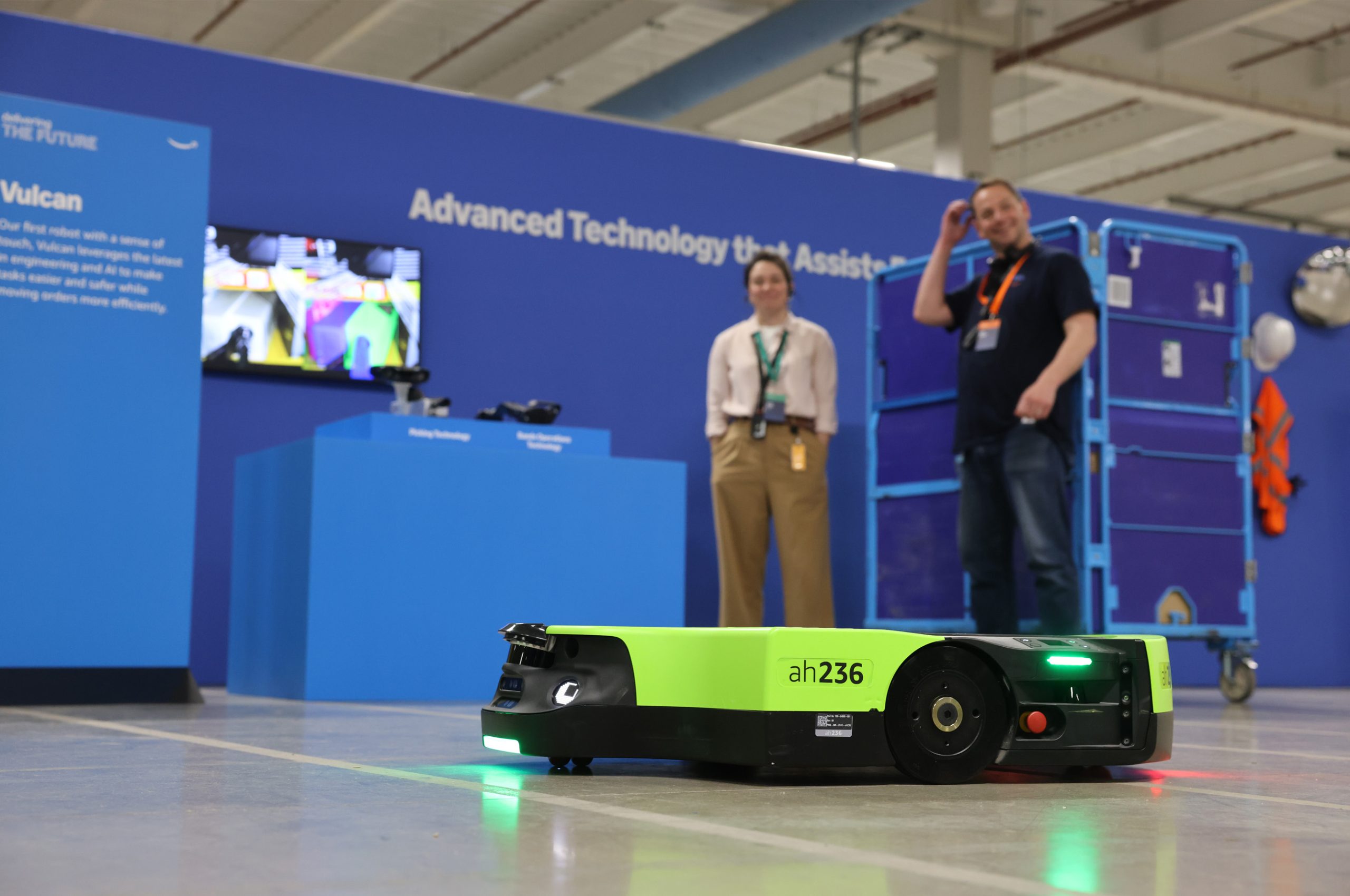
The star of the show was the next-generation Proteus — Amazon’s autonomous warehouse robot, rebuilt from the ground up. The original Proteus was impressive but bounded: it moved heavy carts in dock areas and stayed within designated lanes. The new one has no lanes. It can operate anywhere across an entire fulfillment site, transporting containers as they arrive, transferring them between workstations, and — here’s the leap — responding to plain conversational language from employees. No interfaces. No programming. No technical commands. You tell it what needs doing, and as VP of Amazon Robotics Scott
Dresser put it on stage: “It figures out the priority, the route, the timing. It becomes your assistant for material movement.”
That’s a significant conceptual shift. This isn’t a robot that follows instructions. This is a robot that understands intent. The distinction matters enormously, because it’s the same shift happening across every layer of enterprise technology right now — from chatbots graduating into autonomous agents to code assistants that don’t just autocomplete but architect.
Alongside Proteus, Amazon unveiled Vulcan — the company’s first robot with a genuine sense of touch, capable of simultaneously seeing and feeling objects to navigate densely packed shelf environments — and STARK, a collaborative tote-handling system born from a frontline operations employee’s idea to reduce repetitive heavy lifting. STARK was first piloted in Barcelona and is now deploying to 15 European sites by 2027. That detail — a robot conceived on the warehouse floor — is worth pausing on. The innovation cycle has inverted. Workers aren’t being replaced; in this instance, they’re the ones filing the brief.
The EV story deserves equal weight. Amazon has crossed 50,000 electric delivery vans globally, halfway to its 2030 target of 100,000. Europe clocked over 100 million micromobility deliveries in 2025 alone — by electric cargo bikes, mopeds, and on-foot couriers — saving more than 17,000 metric tons of carbon emissions in a single year.
For India specifically, two announcements cut through the noise. First: Amazon Now, the 30-minutes-or-less ultra-fast delivery service, is expanding internationally — and India is a named priority market, alongside the UK. Second: Amazon committed $1 billion to Career Choice by 2030, a fully-funded upskilling programme that has already put 300,000 employees globally through training in cybersecurity, software development, mechatronics, and renewable energy. In a country where over 80% of Amazon’s India deliveries already depend on its two-wheeler delivery network — a model built nowhere else on earth — these announcements aren’t peripheral. They are pointed directly at us.
ACT TWO: Meta’s ‘Conversations’ — WhatsApp Goes to Work
Running simultaneously across London, Meta held its annual Conversations conference, and the announcement that emerged will quietly reshape how over a billion small businesses operate — many of them in India.
The Meta Business Agent, rolled out globally on June 3, is now available to every business on WhatsApp, Instagram, and Messenger. What does it actually do? The AI agent can answer customer queries, recommend products, book appointments, qualify sales leads, and reroute complex queries to a human when needed. It responds in local languages. It
Operates around the clock. And it doesn’t require technical setup beyond a business account.
Here’s the India angle that most Western coverage missed: India was the test bed. Pilot programmes ran in India, Mexico, and Brazil — and by the time of the global rollout, over one million businesses in those markets were already live on the platform. The kirana owner taking orders over WhatsApp chat, the boutique sending product catalogues by voice note, the travel agent confirming bookings by message — every one of them now has an AI agent capable of handling the first and second touchpoints of a customer interaction without lifting a phone.
Scale that across more than one billion active daily threads between users and businesses on WhatsApp, Messenger, and Instagram — a statistic Meta shared on stage — and the infrastructure shift becomes visible. WhatsApp is not a messaging app for Indian businesses. It is the business interface. The Meta Business Agent is now the employee at the front desk of that interface.
For enterprise clients, Meta simultaneously unveiled the Meta Business Agent Platform, through which large organisations can configure their own agents and integrate them with third-party services including Shopify, Zendesk, and Shopee. That’s the B2B layer on top of the B2C revolution — and it opens the door for Indian SaaS companies and systems integrators to build on top of Meta’s infrastructure rather than compete with it.
Meta’s London week had a harder edge, too. On the same day as the Business Agent launch, the company announced the results of Operation Disruption Week — a coordinated global strike against criminal scam networks. Meta, Microsoft, Coinbase, Starlink, and other major technology companies worked alongside the US Department of Justice and the Royal Thai Police to disrupt over a million online assets, freeze $3.8 million in digital assets linked to money laundering, and arrest 63 individuals. Twelve technology and security firms pooled intelligence to map the entire attack chain.
This wasn’t a PR exercise. It was a signal that the era of platforms shrugging at criminal misuse of their infrastructure is over.
ACT THREE: London Tech Week — £1.1 Billion, a Future King, and a Nation Betting on Sovereignty
Then came London Tech Week itself (June 8–10), the largest technology gathering in Europe, drawing leaders from 130 countries into the same rooms.
The numbers arrived before the doors even opened. The UK technology sector was valued
at £1.2 trillion in 2026. UK AI startups raised more than £8.2 billion in venture capital in the first half of the year alone — nearly half of all European technology investment. Prime Minister Sir Keir Starmer opened proceedings with a national AI compute strategy anchored by £400 million in specialist AI investment.
But the real centrepiece was Technology Secretary Liz Kendall’s £1.1 billion AI Hardware Plan: £750 million for a new national AI supercomputer — projected to be among the most advanced in the world when deployed in 2030 — £120 million for an AI Hardware Innovation Programme to help British companies design and test novel chips domestically, and £45 million in skills investment backing doctoral training and undergraduate bursaries to build a pipeline of engineers, chip designers, and technicians.
The corporate commitments followed at scale. AMD announced a £2 billion investment in the UK over five years, supporting high-performance compute infrastructure in partnership with Cambridge University. Nebius committed approximately £1.7 billion to scale up to 65 MW of AI capacity by 2027. A £200 million AI Adoption package followed, including a £100 million expansion of the Bridge AI scheme.
The architecture of this ambition is what Indian policymakers should study carefully. The UK is not buying AI capability from the United States or China. It is investing in the foundational layer — silicon design, compute infrastructure, talent pipelines — with the explicit goal of sovereign technology capability. That is a strategic posture, not merely a funding announcement.
And then came the moment no one expected to be the most resonant of the entire week. The Prince of Wales attended London Tech Week for the first time — not to celebrate investment returns, but to address homelessness. His Homewards programme launched the UK’s first Homelessness Data Lab, in partnership with Salesforce and LandAid, bringing together over 25 organisations including Bloomberg, VodafoneThree, Accenture, and NatWest Group. The premise: homelessness is rarely sudden. The warning signs appear in data long before crisis point. With the right tools, early intervention is possible.
Placing the most vulnerable on the agenda of Europe’s most powerful technology gathering was a quietly radical act — and it set a benchmark not just for technological ambition, but for what that ambition must ultimately be in service of.
The India Dimension: From Proof-of-Concept to Architect
Step back from the three London events, and a pattern emerges that should be read very carefully in New Delhi, in Bengaluru, and in every boardroom making technology bets right now.
India is already the world’s proof-of-concept for some of the most important technology of our time. Meta tested its Business Agent — now live for over a billion businesses globally — in India first. Amazon’s two-wheeler delivery network, on which over 80% of its India deliveries depend, is a model built nowhere else on earth. UPI processes more digital transactions than Visa and Mastercard combined. ISRO sends satellites to the Moon for a fraction of what it costs anyone else.
In February 2026, India hosted the India AI Impact Summit at Bharat Mandapam — the fourth in the series of global AI summits following Bletchley Park, Seoul, and Paris, and the first ever held in the Global South. Investment pledges crossed $250 billion for infrastructure-related investments, with approximately $20 billion in VC and deep-tech commitments. Eighty-nine countries signed the New Delhi Declaration on AI.
The substance is not in question. What London demonstrated this week — with precision, with narrative confidence, with billions flowing to sovereign hardware and talent pipelines — is the next challenge India must meet. Not just building the infrastructure, but owning the story of having built it.
The shift from technology consumer to technology architect is already underway in India. The Amazon announcements confirm India as a strategic delivery market. The Meta rollout confirms India as the global testbed for AI-powered commerce. London Tech Week’s hardware sovereignty push points directly at the road India must accelerate down — from GPU compute access for startups to domestic silicon design capability.
London moved the world last week. India, as it turns out, had already started running.
The author covered Amazon’s ‘Delivering the Future’ event, Meta’s Conversations conference, and London Tech Week 2026 on the ground in London.