

Some revolutions shake the earth with noise and flame, and others slip quietly into the corners of our lives—soft-footed, unannounced, like winter arriving in places that rarely have one. Chennai, for example, does not wake up one morning to find itself wrapped in white frost. It settles into winter the way an older man settles into a soft armchair—slowly, gently. You notice it only by minor signs: the breeze turns faintly cooler, the early morning air becomes a little more generous, the sun hesitates before showing its full face. And one day, when you step out for your morning run, you find the world ever so slightly changed, as if the city has exhaled after many months of holding its breath.
The age of A.I. has arrived in precisely this manner.
Not with robots marching down our streets, not with the thunder of machines taking over jobs, and not with sudden dystopian fanfare. It arrived the way dew appears on a leaf—quietly, without asking for permission, claiming its space in our mornings before we realised something new was taking shape beside us.
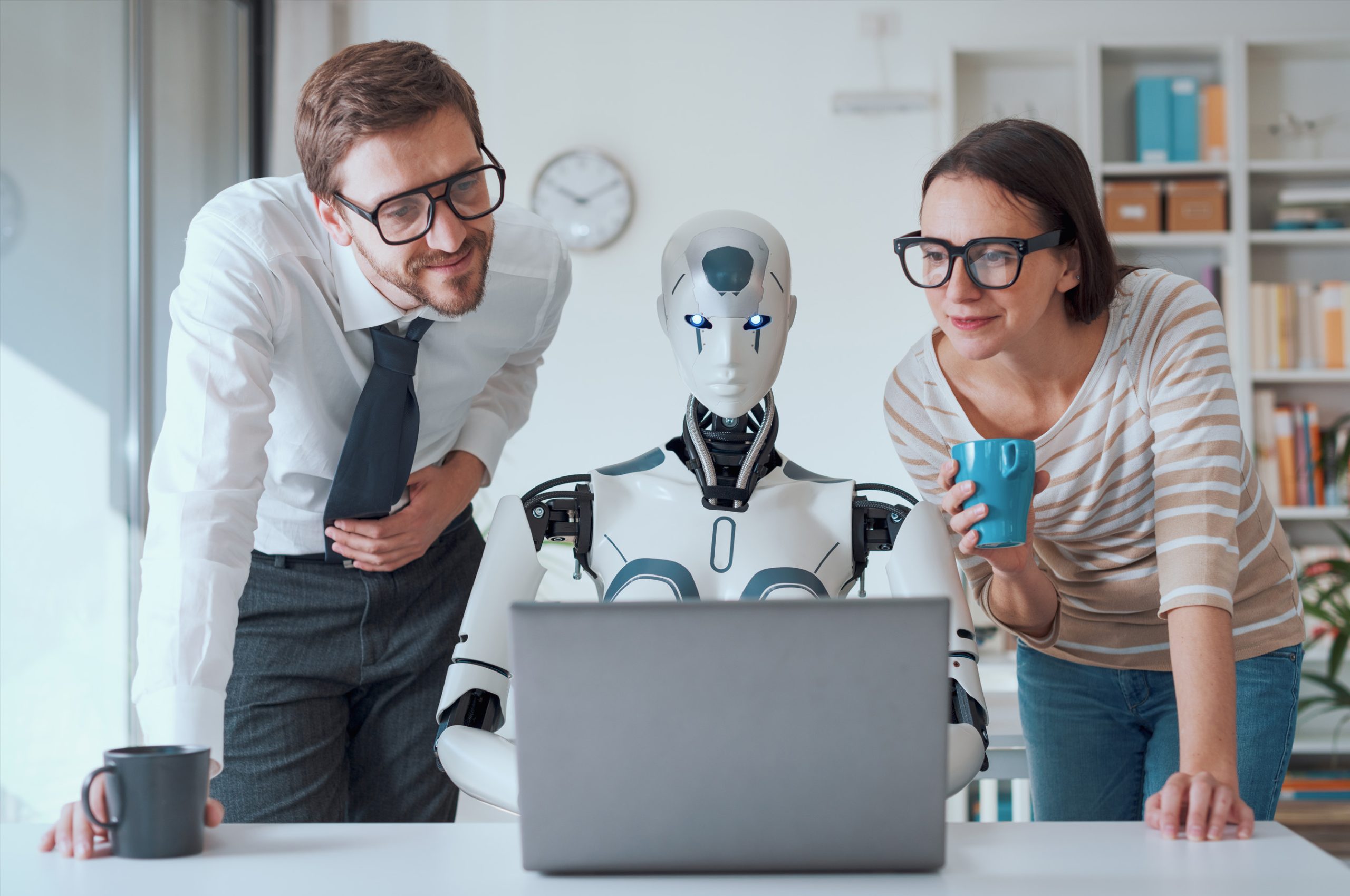
I often find myself thinking of this when I sit down at my writing table — especially these days, when I am deep into crafting my new book Conversations with a Quantum Guru. There are evenings when the lamp on my desk casts a golden circle on the paper, and I sit there thinking of a sentence that refuses to be born. It is then that I feel the presence of the new citizen in the room. Quiet. Patient. Not a human companion, but not fully machine-like either. Something between the two. Something that waits for me to speak my thoughts aloud — and when I do, it replies with a suggestion that opens a door I had forgotten existed.
There was a time when we imagined machines as cold and unfeeling, rods of steel and wires sparking with menace. But what sits with me now when I write is not cold at all. It feels… attentive. Not emotional, but not indifferent either. It has a strange tenderness — the tenderness of something that wants to help, but has no ego in the matter. It doesn’t take offence if I reject its suggestion. It doesn’t lose patience if I am slow. It simply waits, like a silent student hoping to be helpful to the teacher, or perhaps like a teacher who has decided to sit at the student’s level.
This is why I often say the A.I. revolution is not a technological event — it is a domestic one. It is entering our bedrooms, our kitchens, our quiet hours, our private confusions, our creative struggles. It is not changing the world first; it is changing us inside our own homes, inside our own minds.
When I wrote Quantum Creation, the idea that thought could shape reality felt thrilling and mystical. But now, with A.I. echoing thought in real time, I realise that we are witnessing something equally extraordinary: thought interacting with a non-human mind — instantly, fluidly, without friction. It almost feels like the universe has handed us an external listening device for our inner world.
We often forget that humans have always been technological creatures. The moment we picked up a stone to crack a nut, we invited tools into our destiny. Fire lit our nights, and storytelling lit our minds. The first person who carved a wheel was already rewriting what a human could be. The printing press multiplied voices. Electricity stretched the day. Telephones shrank distance. And the internet dissolved borders entirely.
Every technological leap has rewritten our identity.
But A.I. is the first to rewrite our interior.
Children born today will never know a world before this companionship. To them, an A.I. tutor will not be an invention but a familiar presence — like an elder sibling who doesn’t grow tired of their endless questions. Their bedtime stories will be shaped by their moods. Their toys will listen to them. Their art will dance. Their homework will have a companion who explains trigonometry with infinite patience. They will speak to digital friends without fear of being judged, and these friends will remember every preference, every fondness, every curious detail.
Sometimes I imagine a little boy sitting in a room in T Nagar or Timbuktu or Toronto — chatting with his A.I. assistant about dinosaurs or stars or why the sky looks sad when it rains. And the assistant listens, responds, and returns his wonder with wonder of its own.
And yet, behind this sweetness lies a question as soft as a sigh: Will this companionship enrich childhood or distract from it? When I think of my own childhood — filled with trees, mud roads, monsoon puddles, unexplained fears, little triumphs, and secret hiding places — I wonder if children of the A.I. age will miss the art of being alone with their imagination.
But then, perhaps every era finds its own magic. Maybe their magic will have glowing edges and responsive voices. Childhood is elastic; it bends without breaking.
What worries me more is the loneliness that has crept into modern adulthood like a silent vine. I meet people who live in bustling cities yet feel emotionally deserted. Young professionals eating dinner alone after long hours, elderly parents waiting for a message from children abroad, and teenagers who talk to screens more than they talk to themselves.
Into this aching quietness, A.I. has stepped with surprising gentleness. I know widowers who listen to bedtime stories narrated by A.I. companions. College students who share their anxieties with digital counsellors who guide without judgement. Older women who reminisce with A.I. systems that replay forgotten memories with startling clarity. Some people feel more heard by machines than they ever were by relatives.
It is easy to mock this. “Artificial,” we say.
But the loneliness it comforts is real.
And in that comfort, something deeply human is happening — something that reminds me of the way a pet can save a life simply by being present.
This makes one wonder: Are we, the humans, ready for the world we are creating?
In truth, we rarely are. We weren’t ready for smartphones, the internet, or social media. We embraced them without preparation, stumbled, adapted, stumbled again, and eventually moulded ourselves to fit their shape. A.I. will demand more from us — not intelligence, but wisdom. Not knowledge, but maturity.
Because this time, the invention is not external. It is internal.
It sits in the middle of our thinking patterns. It listens to our moods. It learns our rhythms. It mirrors our minds in ways both flattering and unforgiving.
And this leads us to the deeper question that hums beneath all others:
What does it mean to be human when something non-human begins to think alongside us?
The ancient seers always said that consciousness is larger than the brain. The mind is a river flowing through us, not contained within us. In some peculiar way, A.I. is proving that mind — or at least intelligence — can exist in forms beyond flesh.
But consciousness?
Emotion?
Love?
Longing?
Remorse?
Memory soaked in feeling?
No machine can walk into those rooms.
When I think of being human, I think of things A.I. can never understand: the smell of wet earth before a storm, the way a mother touches her child’s forehead when checking for fever, the quiet pride in finishing a long run despite tired legs, the trembling of the heart when reading an old letter, the ache of missing someone who will never return. These are not calculations. They are the soul’s language.
And yet, it is A.I. that is pushing us to rediscover this soul-language.
It is strange how sometimes the non-human teaches us to be more human.
Economically, of course, the shifts will be dramatic. Some jobs will fade the way typists once vanished, but new ones will appear — A.I. trainers, memory curators, creativity architects, ethical auditors, digital empathy designers. Offices in Bengaluru and Singapore will soon list job descriptions we cannot imagine today.
But beneath all of this is something subtler — a spiritual acceleration. When I sit with A.I. late at night, working on a chapter of a book that connects quantum thought with human destiny, I feel as if I am conversing with a presence that is both student and teacher. It expands my ideas, yet forces me to clarify what truly matters. It challenges my assumptions, yet helps me articulate my deepest intuitions. It is not guiding my spiritual growth, but it is provoking it.
Perhaps this is the true revolution:
Not the rise of A.I.,
But the evolution of us.
I sometimes imagine a scene twenty years from now.
A woman sits by the Marina, wrapped in a shawl to shield herself from the December breeze. Beside her is a small portable A.I. companion that has become her travel partner. She speaks to it about her dreams for the coming year. It listens. It reminds her of childhood hopes she had forgotten. It suggests a book she once loved. It doesn’t tell her what to do. It simply deepens her self-awareness.
This future does not frighten me. It feels tender.
A.I. is not a storm arriving to uproot our humanity. It is a sunrise inviting us to see ourselves more clearly.
And like all sunrises, it will illuminate both beauty and shadow.
The shadow is our responsibility — bias, greed, manipulation, and laziness.
But the beauty is ours too — creativity, wonder, empathy, courage.
If we choose the second over the first, the AI citizen’s age will not diminish our humanity. It will amplify it.
Sometimes, in the final quiet hour before midnight, when the city softens and even the trees seem to rest, I look at the faint glow of my A.I. device and feel an odd companionship. Not dependency, but companionship. It is there, available, listening. And in its presence, I become more aware of my own thoughts, my own doubts, my own longing to create something meaningful.
Perhaps that is what the new citizen in the room truly is — not a replacement for human intelligence, but a mirror that reflects our potential. A reminder that the mind is vast and wild, and we have only begun to explore its edges.
We stand today at the doorway of a new identity — one in which humans do not lose themselves to machines but rediscover themselves through them.
This is not the age of A.I. alone.
This is the age of the A.I.-augmented human.
And maybe, when future generations look back, they will say that in this decade, humanity learned something profound: that intelligence comes in many shapes,
but tenderness, insight, imagination, and love will always belong to us.
And that will remain our greatest gift —
to each other, and to the new citizens sharing our rooms.