

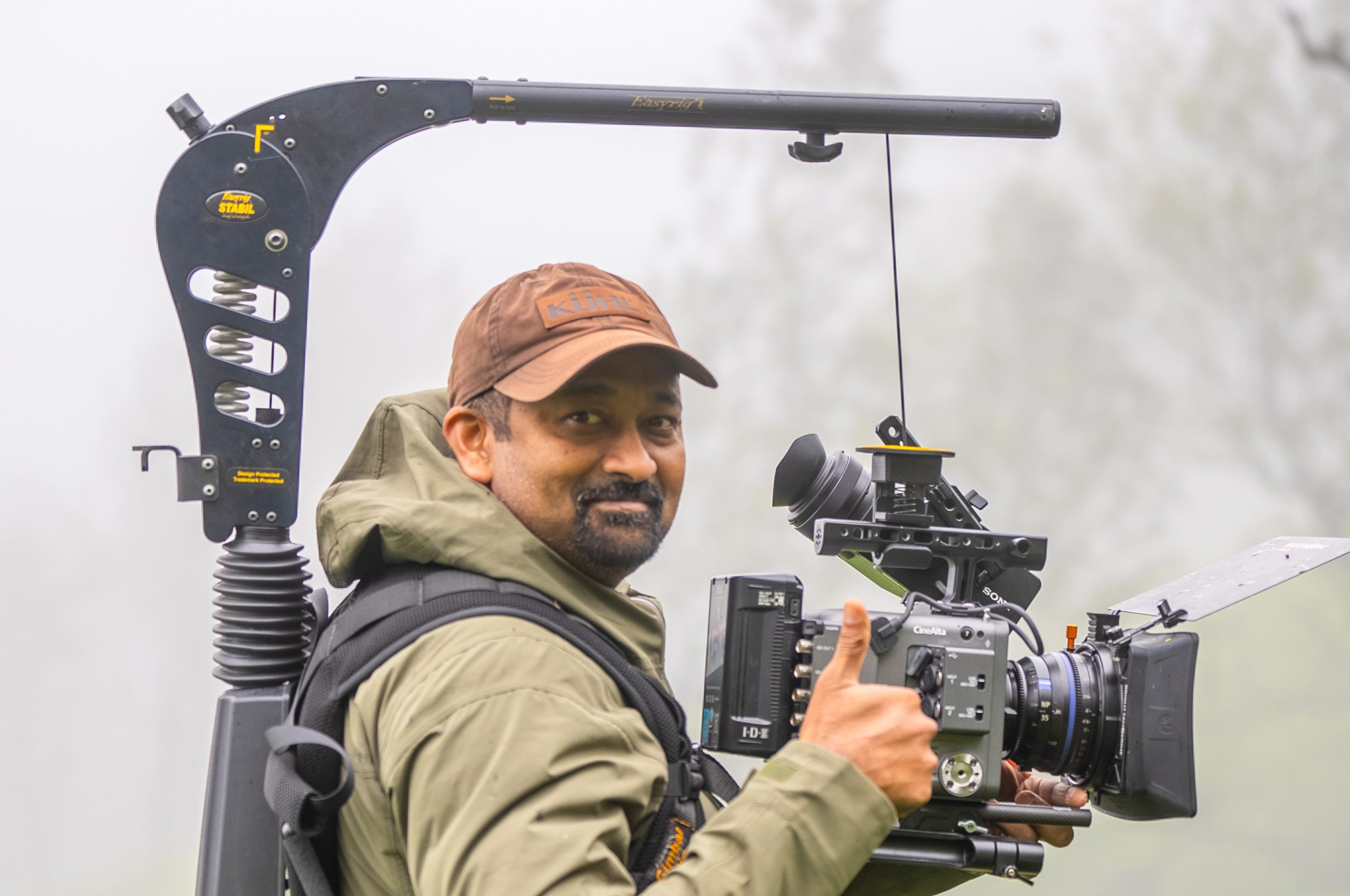
His tryst with the camera began at just 13, eventually blossoming into a lifelong passion for wildlife and filmmaking. Over the years, Sandesh Kadur has journeyed deep into the natural world, uncovering and sharing some of its most extraordinary treasures with global audiences.
His visual storytelling spans the elusive snow leopard in the Himalayas, the mist-covered peaks of the Western Ghats, the thriving Okavango Delta in Botswana, and the endangered Kemp’s Ridley turtles in Mexico — to name a few.
Driven by a mission to protect threatened species and spotlight urgent conservation issues, Kadur’s cinematic works have aired on renowned platforms including National Geographic, BBC, Netflix, Discovery Channel, and Animal Planet. His contributions have earned global recognition, including an Emmy nomination and a BAFTA Award for BBC’s ‘Planet Earth II’.
Recently creating headlines for his latest documentary, ‘Nilgiris: A Shared’ Wilderness’ — presented by Rohini Nilekani Philanthropies and Felis Films — Kadur speaks to Provoke Lifestyle about his early influences, the making of the film, and the deeper message behind his awe-inspiring frames.
To start with, could you tell us a bit about your early connection with nature and what drew you towards wildlife photography and filmmaking?
My very first tryst with the camera began when I was about 13. My father, Dr. B.N. Vishwanath, an entomologist by profession, but photographer at heart, taught me the basics and occasionally allowed me the use of his Nikkormat camera. That was enough. I have been hooked ever since.
Filmmaking came to me at a much later stage. I was in college at the University of Texas at Brownsville and the college had a very active science foundation known as the Gorgas Science Foundation, headed by senior professor Lawrence V. Lof. He saw my enthusiasm and gave me my first opportunity to work on a documentary about the Western Ghats of India. This was when my photography transformed into cinematography and soon, after I became fully enraptured in the world of wildlife filmmaking.
You’ve spent decades documenting India’s biodiversity — what gets you excited about telling stories of the wild?
When I was in my early teens, I watched a documentary that had a quote by the Senegalese environmentalist Baba Dioum, saying, “In the end, we will conserve only what we love, we love only what we understand, we understand only what we are taught.”
I believe people forget what’s not seen. So, my job is to uncover the unseen and really bring the significance of those unseen species to life. I want to help people connect emotionally with the beauty of the wilderness, bring conservation issues to light, and raise awareness in a way that fosters respect and concern.
I believe in hitting people on the head with visually powerful films that convey science through storytelling to make them understand and expose how much we are losing and emphasise the need to conserve what we have left.
Let’s talk about your latest film – Nilgiris: A Shared Wilderness. What sparked the idea for this project and what was the journey like from concept to screen?
This journey began about three years ago with a conversation between Rohini, Nandan Nilekani, and myself. Rohini, who spends a lot of time in the Nilgiris, brought up the topic during one of our evening walks. Despite extensive literature on the Nilgiris, we found no comprehensive documentary specifically about this mountain range, a surprising discovery considering its status as India’s first UNESCO biosphere reserve. That realisation sparked the ambition to create one.
It’s the story of a new wilderness, a mostly human-made landscape, where wildlife continues to adapt and thrive. Where else in the world can you have black leopards, gaur, sloth bear, etc. all living in a tea garden? This is the story of a modern wilderness and Rohini Nilekani and I want the audience to remember that we too are part of nature.
What were some of the biggest moments for you while shooting this film?
While filming, our whole team had some amazing moments! Mine in particular was seeing the Great Hornbill chick struggling out of the nest and emerging for its first time into the outside world! That was an extraordinary, unexpected moment and I’m fortunate to have witnessed it.
The Nilgiri Biosphere Reserve is a vast and complex ecosystem. What were some of the biggest challenges you faced during production?
The toughest part of the project was actually finding unique stories like that of the endemic Salea lizard, only found in the Nilgiris and nowhere else in the world. Perseverance was key. We were going to the same location or waiting for that one shot for several days. The hornbill scene took 70 to 80 days. We had to literally go every day to observe the hornbill coming out.
And the leopard cub sequence—some days we would sit there from 6 am to 6 pm waiting and it would not show up. There was no guarantee. And yes, these scenes would unfold at quite a distance from us, sometimes more than 500 metres away.
With increasing habitat loss, climate change and human-wildlife conflict, what concerns you most about the future of ecosystems like the Nilgiris?
The nature of the place is such that there’s a lot of wildlife spill over into tea gardens, private homes, and other spaces, where species like leopards and gaur are increasingly seen cohabiting with humans. However, while wildlife numbers are declining globally, the Nilgiris present a ‘reverse story’. That is important to acknowledge.
This is the story of a new wilderness, a mostly human-made landscape, where wildlife continues to adapt and thrive. Where else in the world can you have black leopards, gaur, sloth bear, etc. all living in a tea garden? Although it’s in a constant state of change, it also shows nature’s resilience and adaptability to survive the odds — but only if we allow them the space to do so.
As someone who works at the intersection of science and storytelling, what kind of impact do you hope films like this will have on viewers?
This is an educational documentary disguised as entertainment. Throughout the film, people are constantly learning, but in a way that’s engaging and enjoyable—they won’t even realize it’s educational in the traditional sense. Entertainment is the capsule in which we deliver education.
Rohini Nilekani and I hope that this film reaches more schools and colleges. We also hope this film will become part of the curriculum so that children grow up with a greater sense of appreciation for those hills.
We want millions to see this work. A huge amount of effort has gone into making this film, and we don’t want to keep it in a closet. I want people to leave feeling a sense of awe and wonder. I want them to feel like they’ve discovered something special—something worth conserving. That emotional connection is what matters most.
What’s next on the cards? Are there other landscapes or stories you’re eager to explore through film in the near future?
India is a treasure trove of stories. Even if we’ve filmed in a particular landscape before, there’s always more to discover — more stories that deserve to be told.
I’m particularly drawn to our river systems — they’re lifelines, supporting everything from remote wilderness to major cities, yet they remain underrepresented. There’s an urgent need to showcase their ecological and cultural significance.
I’m also eager to explore the Eastern Himalayas and the Northeast of India in greater depth. These are landscapes teeming with biodiversity, home to indigenous communities with deep-rooted relationships with nature.
Ultimately, the goal is to create films that evoke a sense of wonder while grounding viewers in the reality of what we stand to lose.