

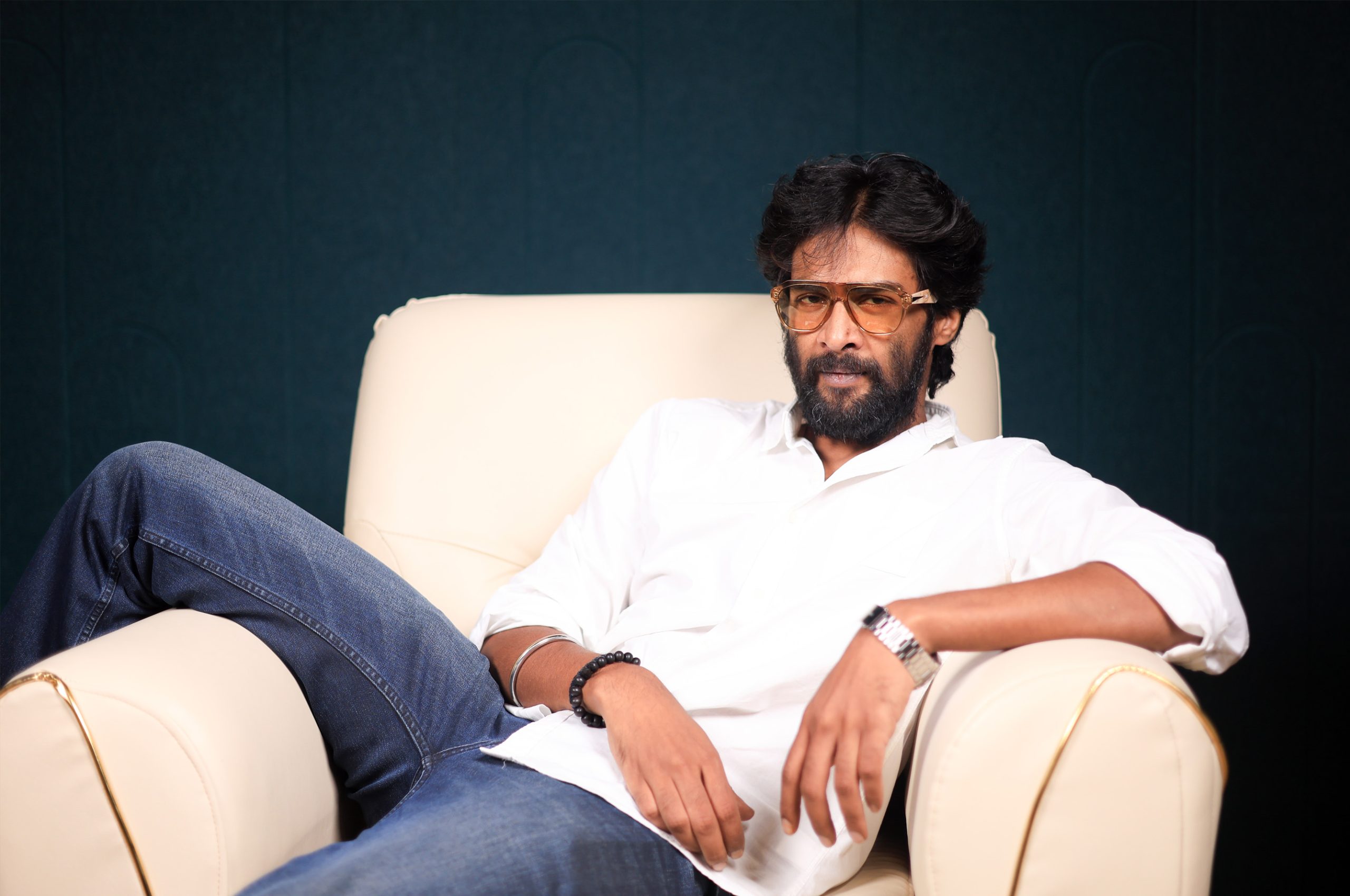
After delivering a chilling performance as the menacing nomad Shettani in Jigarthanda DoubleX, Vidhyashankar Neelamegham — better known as Vidhu — stormed the big scream with yet another fierce portrayal, this time as the ruthless Michael Mirasu in Retro. With his towering presence, piercing gaze, and undeniable charisma, Vidhu has quickly carved a space for himself in Tamil cinema’s gallery of compelling antagonists.
We caught up with the actor fresh off the film’s success, and yes — he checks all the boxes for tall, dark, and handsome. While many assume he’s only drawn to villainous roles, the truth isn’t too far off. Vidhu’s journey into acting was ignited by a character from the intense and cerebral world of Christopher Nolan — one of cinema’s most formidable auteurs. That early spark led him to explore the darker shades of storytelling.
But make no mistake — there’s more to Vidhu than just brooding stares and calculated menace. Behind the grit is a soft-hearted romantic, a self-proclaimed lover boy, and an actor eager to explore every shade of human emotion. The masks may be dark, but the man behind them is far more layered.
You’ve been passionate about films since childhood. Can you share who your favourite actor was growing up and the moment that truly sparked your love for cinema?
It’s such a clichéd moment to talk about, but honestly, the first time I really wanted it—like truly, deeply wanted it—was when I saw Heath Ledger in The Dark Knight. There was just something about the impact he had. I think that was the first time I ever bunked college to go watch a film. I was in Chennai, studying at Sathyabama. And something happened to me in that theatre that day—it’s hard to explain. Whatever he did with that performance, it just hit me. It was outstanding. Completely unforgettable.
Coming from Coimbatore — a city that’s given us legendary actors like Sivakumar, Sathyaraj, Suriya, and Karthi — was there a particular moment when cinema started to feel personal or real to you? What brought you to Chennai, and in such a competitive industry, how do you view success or define your ultimate ambition?
Yeah, I’ve told Suriya sir about it. He was actually the first actor I ever met. At the time, I was just a regular person—we’d just finished school, and one day, we were sitting at a Barista, having coffee, when they came to shoot a song for Jillunu Oru Kadhal. That moment really stuck with me.
I came to Chennai because, honestly, there wasn’t much happening in terms of cinema back in Coimbatore. People often talk about all the big names from here—Sivakumar sir, Sathyaraj sir, Suriya sir, Karthi—and of course, legends like Goundamani and Kovai Sarala. I’ve always loved comedians, actually. There’s something so special about what they do.
My ultimate ambition is just to stay—stay in this space. And I feel like if I keep showing up and giving 100%, something out there is waiting for me. I don’t know what it is, and honestly, I don’t want to define it. I’m okay, just going with the flow, trusting my work, trusting the universe, and seeing where it takes me.
You landed a physically demanding breakout role in Jigarthanda DoubleX, followed by Retro. Director Karthik Subbaraj is known for working with a recurring cast and crew. How did you manage to earn his trust and secure such pivotal roles?
I had to break certain perceptions, you know? Maybe there were some assumptions people had about me—that I just looked nice and wanted to become a hero and get famous. And for a while, I think that lens was definitely there.
I was a junior artist in Petta, and then I did one scene in Navarasa, in the Peace segment. After that, I had a film called Boomika where I played the lead opposite Aishwarya Rajesh—but it came out on Netflix, so I had that going. I think that phase can be seen as one portion of the journey—you can kind of split it there.
And then COVID happened.
After COVID, we did a film called Neelira with Stone Bench. It’s a very heartwarming, emotional kind of movie. And now with Neelira, Jigarthanda DoubleX, and Retro, it feels different—like, okay, now I’m actually working. It feels like there’s been a shift from where I was before.
But during the Neelira shoot, he came to the spot one day—they were producing it again—and Karthik Subbaraj was there too. I think maybe something he saw that day sparked the idea to try me out for an audition for Shettani.
We know you started as a junior artist in Petta and later captured attention with two intense, menacing roles. But what about the journey before that? Can you take us through your transition from being an engineering professional to stepping into the world of cinema?”
So I was in engineering, and then for about a year and a half to two years, I was working in Coimbatore. Around that time, they were just about to start Stone Bench in Chennai. Karthik had just come back from the UK, and I’ve known them from before—through family. I told him I wanted to be in cinema. By then, Pizza had either just been made or was in the process.
He said he was coming back and getting into production, into cinema, and I told him I wanted to act. I think at that time, maybe there was a certain lens through which they saw it.
I spent around five or six months in Chennai while they were setting up Stone Bench. I got really impatient because I wanted to act, but we were doing subtitling and other things. Looking back, that’s really where it all started. But I didn’t have the maturity to understand that then—I was young and wanted things to happen fast.
When I realised it wasn’t going to happen that way, I decided to study. I went and did an MBA in project management for a year and a half. Then I went back to Coimbatore and worked there for another year and a half.
But that calling—it just kept coming back. Again and again. And then, one fine day, I just decided, “Okay, I’m leaving. Wherever this takes me, I want to take that path and see where it leads.
Your decision to leave your job and pursue acting—did that feel, in some way, similar to Karthik Subbaraj’s own journey of quitting his job to enter cinema? Was that something you related to or found inspiring?
Yeah, subconsciously, he might’ve even been an inspiration for me to quit what I was doing. I mean, I was earning well, settling down—you could easily just stay in Coimbatore and live a normal, comfortable life. But I wanted to take myself out of that comfort zone. And looking back now, I think it’s worked out okay.
Beyond these villainous roles, what kind of characters are you excited to explore — period dramas, superheroes, romance, or something else entirely?
Anything, really. I’m just open to good characters—ones where I can actually work, you know? Not in a purely functional way. Nothing against people writing functional villains—it’s super important for mass commercial cinema, and I completely get that. But I don’t think it’s my cup of tea. I don’t really see myself going in that direction.
For me, it’s more about growing as a performer, staying focused on that path, and seeing where it leads. I look at people like Daniel Day-Lewis or Leonardo DiCaprio—they’ve really carved out their own space by just committing to the craft. And I feel like maybe that’s possible here too, in our own way. I’d love to try and work like that and build something of my own.
Watching your performance and the commitment you showed in Jigarthanda DoubleX, I couldn’t help but see shades of Vikram sir — someone known for completely transforming himself for every role, whether it’s losing weight or bulking up. Are you the kind of actor who’s willing to go to such physical extremes for your characters?
Yeah, I think some of the most inspiring actors for me here are Suriya sir and Vikram sir. They’re two people who really go through complete transformations for their roles. You don’t see them as the same person from one film to the next—except maybe in some of the more commercial films they do, you know what I mean. But most of the time, they’re exploring such different characters, and that’s something I really admire.
You see that shift. And that’s the space I want to be in. I think that’s what I truly love about acting—that you get to completely transform yourself, become someone else entirely.
Of course, it depends on the character. Like in Shettani, it was a very physical role. There wasn’t much dialogue, no quirky behaviour or big emotional arcs—he didn’t even have to feel entirely human. So it was more about tapping into your most raw, animalistic instincts and just training your body to obey your mind. Once I did that, I felt like I’d cracked a good part of the character, apart from the few lines I had.
But with Michael, it was a completely different experience. He’s a very cerebral character—super sharp, very manipulative, with all these intense emotional highs and lows. He’s always smoking, he’s unpredictable… So that role was more internal. It was about trying to really capture his essence.
Before we even started shooting, we had a lot of auditions and back-and-forth workshopping, which really helped. By the time I actually got on set for the first day, I already felt like I was living as Michael. And that feeling—that deep connection with a character—it felt really good.
You received praise from Rajinikanth sir for your powerful portrayal of Shettani in Jigarthanda DoubleX. Now, with Retro running successfully, did you receive any special appreciation this time as well? And how has the audience responded to your performance?
No, I think now it’s more because the audience is starting to recognise me. The other day, I just stepped out like normal, went to the local smoke shop nearby, and suddenly, two people pulled up on a two-wheeler and were like, “Hey, King!” And I was like, oh shit… okay!. That moment really hit. it was small, but it felt real. Like something’s starting to shift.
Could you share some of your favourite performances from both world cinema and Indian cinema? The ones truly inspired you.
Thalapathy, Rajinikanth, Nayagan, Kamal Haasan—if you want me to go the Indian route, those are the ones. And then if you look internationally, definitely Heath Ledger, Leonardo DiCaprio—pretty much everything he does. Al Pacino in Scarface, yeah, things like that.
And of course, Johnny Depp in Pirates of the Caribbean—I honestly think that’s one of the most challenging roles ever written and performed. There’s so much inspiration to take from all of them. The kind of work, time, resources, and energy that go into bringing those characters alive—it’s incredible. There’s a lot to learn, and a lot of inspiration to take from everywhere.
After the success of Retro, what’s next? Any exciting projects in the pipeline—perhaps collaborations with big stars or a shift in roles?
You’ll know in about a month or less. Not big stars or anything, but yeah, there’s something in the pipeline. I think it’s better if you just see it when it comes out. I want to see how it all unfolds organically and what it leads to this year.