

Intro:
Don’t have time to read self-help books? I’ve got you covered with just three beautiful aphorisms that can level up your peace and happiness.
Column:
One of the great things about being a voracious reader in today’s world is that there is no shortage of free content to read, provided that you don’t turn your nose up at writing that lives on the internet, such as blog posts and newsletters. Even if you aren’t a reader, the ubiquity of podcasts has been a wonderful way for auditory learners, or just busy people, to absorb stories and information. It is through this proliferation of life advice and everyday wisdom that I have come across a few golden aphorisms that brought about powerful mindset shifts, which in turn help me move through life with more confidence and peace. These sayings apply to both men and women, though I will focus more on how women can benefit from following them, as I am wont to do!
The first simple truth that opened my eyes to a new way of thinking is “ ‘No’ is a complete sentence.” Again, while gender neutral, this philosophy may be more impactful on women because women are more likely to be people-pleasers than men. The world has taught us that it is our job to be soft, giving, and servile. While it is true that women are more naturally nurturing, and that this is a gift and a strength, it becomes a weakness when we feel we have to constantly give of ourselves, and show up even when our tank is running low. And once you’ve shown people that you are helpful and competent, they tend to ask more and more of you (another saying that applies here is “Give them an inch, and they’ll take a mile”!).
Allow me to take a small detour: I first heard this mindset mantra in a rare interview given by the Olsen twins, who had learned it from their mentor, iconic fashion designer (and populariser of the wrap-dress), Diane von Furstenberg. I had the giddy glory of enrolling in New York University the same year as the celebrity twins, and I take their wisdom seriously, as they are phenomenally successful businesswomen who have massive cultural impact while shunning fame–the opposite of “thirsty” in a world of people trying to go viral.
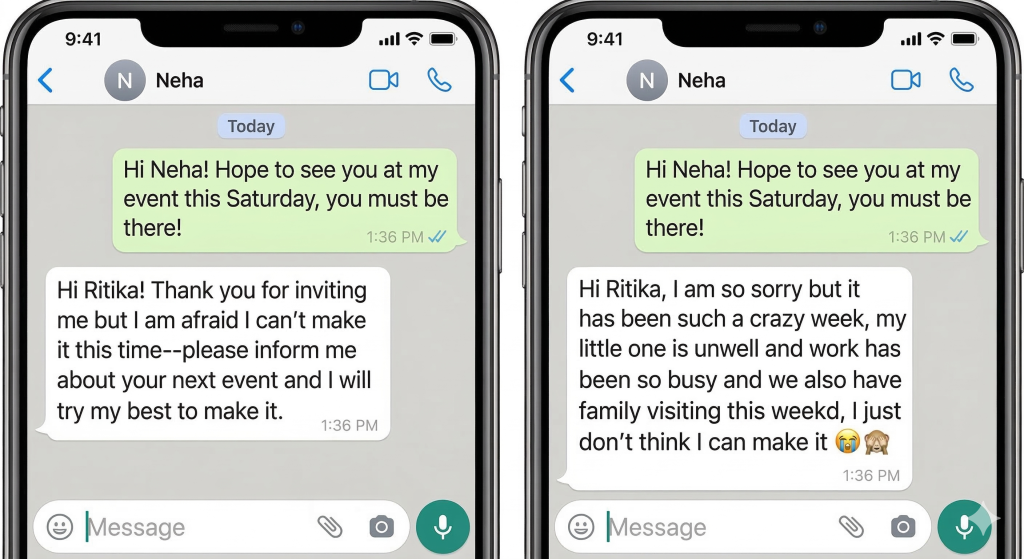
Back to being a giving woman–before you know it, you are accepting extra projects at work, volunteering for multiple events at school, hosting more family gatherings than you would prefer, and attending more social engagements than your battery can handle. Now let’s say that you finally muster up the courage to start turning requests down. Your response probably starts off with “Sorry” before giving several lines of explanation as to why you cannot do the thing being asked. This is the moment when I want you to repeat: “ ‘No’ is a complete sentence!”
This is not to be taken so literally; I am not advising you to start giving one-word rejections that can come off as rude or abrupt. You technically have every right to do that, but we can still establish boundaries while remaining polite and kind. What the saying means is that you do not have to explain yourself just because you are saying no. You don’t have to justify your nos any more than you justify your yeses. By explaining yourself, you are implying to yourself and the other person that you are coming up short or not doing something you’re supposed to. But the fact is, no one is entitled to your time and energy, so you do not have to apologise when you opt out.
The next guiding principle that I loved from the moment I grasped it is “Done is better than perfect”. There are so many levels on which this can apply. You can probably think of countless times you did not end up doing something because you were waiting on some other factor; for example, not having your friends over until you upgrade your furniture, or not sharing your business plan with your mentor until you do another round of market research. A very common example is couples waiting for their finances and schedules to reach some ideal state before they start trying for a baby. If aspiring for perfection, or an unrealistically high standard, is delaying some action that you plan on taking, you need to repeat after me: “Done is better than perfect!” Having high standards is great, but not if you are using those high standards as an excuse not to even attempt the thing in the first place. Learning only comes from action, not preparation, so just get it done without waiting for the ideal circumstances.
There are many instances in daily life where applying this maxim will push you past procrastination into action. Perhaps you spend twice as long as needed on a simple email to your boss, to ensure perfect tone and word choice. Sending an imperfect email in a fraction of the time is the smarter move here, especially because any boss values efficiency over perfect email etiquette. Another example is skipping a workout entirely because you don’t have a full hour–but even 15-20 minutes is better than nothing, and any trainer will tell you that consistency is more important than intensity. Finally, you may be holding back from sharing your creativity with the world, not posting your writing, fashion, or art content until it is perfectly glossy and edited. But the longer you wait, the more time you are losing out on seeing where it could take you. So be bold, march forward and take any action that has you ticking something off your list as “done”!
The final phrase to live by that I want to share with you is something you can use when you are feeling overwhelmed with your never-ending to-do list. Your mental monologue may usually sound like this: “I have to help my kid with her homework.” “I have to go to this work event.” “I have to do laundry.” When this grind is getting you down, try switching the word “have” with “get”, so instead of “I have to”, you think “I get to”. By changing the obligation to a privilege, this phrasing reminds us that we can be grateful even for the dreary, tiresome, less glamorous parts of our lives because we are ultimately blessed to have those too. I get to help my child with homework because I have the free time, knowledge, and patience to help him–isn’t that lovely that I am equipped with those resources? I get to go to a work event–isn’t it fortunate that I have a steady job, one that gives me opportunities to mingle with my coworkers away from the office? Even in the laundry example, aren’t we privileged to have clothes and the means to launder them?
Obviously this sweet little word swap works better in some situations than others. You may not ever feel like washing dishes is something you “get” to do. But with an open mind, this perspective shift can be very effective, especially for people who tend to feel sorry for themselves. The privilege of being alive, contributing to society, and having a family comes with a ton of upkeep. When you feel you are too submerged in that upkeep to actually enjoy life, reminding yourself that you “get” to do all this can connect you back to the blessing at the origin.
To recap: “No” is a complete sentence–you are allowed to say no without explaining yourself. Done is better than perfect, so stop worrying about achieving the ideal outcome and get cracking with whatever you have to work with now. And next time you are bummed about something you have to do, try telling yourself that you get to do it instead. I hope these guiding principles help you as they have helped me, dear readers!