

The other day, I was telling my son how I am the last generation that remembers what it was like before the internet. That is not actually true, but rather a typically millennial statement in which I center myself and forget about the very much alive generations above me who also remember those days, and far more of them!
But you understand the overall gist. It is eerie and exciting and nostalgic to think of ourselves as living time capsules of “the before times”: the warmly lit ‘90s, where a handful of media companies controlled what we consumed; when we had to make do with whatever happened to be playing on the radio or TV at that moment, or whichever videos had not already been checked out at the rental shop.
We checked newspapers for movie timings, and used paper maps (plus directions from strangers) to drive somewhere new. I have to spell it out in such detail because my kids will never understand not being able to do all this, to access the world, from the palm of their hands.
Before my memories erode, let me take this opportunity to weave a vivid tale for the young ones: a time of analog, minimal distraction and no surveillance.
Landlines
Set aside the miraculous means of communication that is texting–can you imagine having to call a landline that anyone could pick up, just to reach someone? We built friendships by calling each other’s homes and asking to speak to one another. Our parents taught us good phone etiquette, and our friend’s families, who answered our calls, judged us by it.
You could eavesdrop on a conversation by picking up another landline in the same house–but our trained ears quickly learned to detect the telltale signs: a click, a faint shift in the line, or a low atmospheric din. Landlines forced us to exchange a few pleasantries with whoever picked up the phone. Another thing to consider was the time of day; it was rude to call during dinnertime or too late.
In my teenage years, the ultimate flex was having your own separate landline connected in your bedroom. Our school directory listed every family’s address and numbers, and several had a personal or “kids’ line” listed under the main house number. What forward-thinking parents to afford their children the privilege of a line of communication that was private and always free for them to use. (Free as in unoccupied, not free of charge–lamenting hefty phone bills by chatterbox teenage daughters was a regular trope on 90s sitcoms.) Because remember: the landline was shared by everyone in the household. So if you were desperate to call your best friend for a post-party debrief, but Mom was on the line with an aunt from India, you had no choice but to wait patiently.
Socialising and Partying
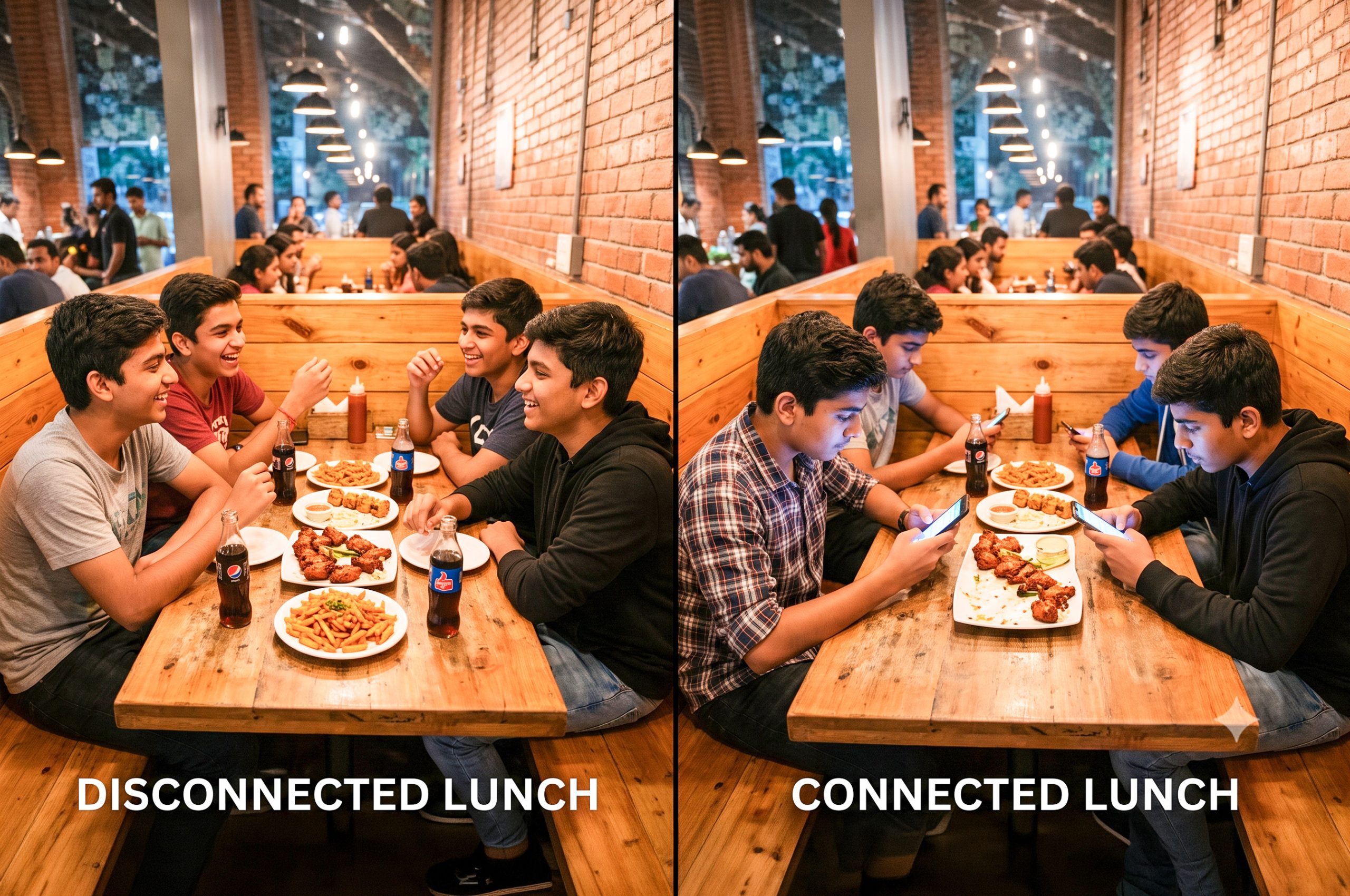
Before cell phones, plans were made in advance with minimum flaking. Once you got together, whether at someone’s house or the mall, you stayed present with each other, rather than having one eye on your phone. We consumed content together differently; flipping through magazines and reading the juicy parts aloud, or watching TV side by side. We fixed a time for our parents to pick us up and had to kill time until then, instant taxis not being an option. The lack of distraction is what I miss most–huddling up with a few friends at a booth in your favourite chain restaurant and sharing appetizers gave us a solid stretch of quality time without a single notification or call pulling our attention away. These days, in any group setting, there is almost always at least one person who is on their phone at any given moment, missing whatever is being discussed at that time.
The lack of surveillance is another freedom we took for granted. Much has been written about the huge drop in alcohol consumption by Gen Z. One overlooked reason for this is that they are worried about losing control and being recorded in an unflattering light. Oh, the things we millennials did under the guise of night, knowing our friends wouldn’t hold it against us, especially with their memories being equally impaired! We drank and danced with abandon, climbed onto bars, stumbled and laughed it off, and fell asleep with our makeup on. We did all this without any handheld device that compelled us to capture every moment or to contact someone who crossed our mind. What freedom! Instead of waking up and anxiously checking our camera roll, Instagram stories we didn’t remember posting, or outgoing calls and texts, we just focused on convincing someone to drive to McDonald’s before they stopped serving breakfast. Later, we pieced the night’s events together as we felt life creeping back into our veins with every greasy bite of a sausage and egg McMuffin.
Work/Life Balance
Our parents built their careers in the time of snail mail and landlines. Once they were home from the office, there were no emails to check, or text messages coming in from business associates in other time zones. Even if it isn’t work-related, our state of constant availability and reachability is draining and overstimulating. That is why the biggest thing I miss about the pre-smartphone era is not being reachable. Remember what I said earlier, that it was impolite to call a landline after a certain hour? Now, we receive WhatsApps at all times of day and night, whether it’s a shipping notification or an important school announcement or a group chat repeating “Happy Birthday!” 20 times. Our brain has to process all these messages from all different spheres of life and then feel pressure to respond sooner rather than later.
There used to be natural barriers between the different parts of our lives. Work stayed, for the most part, at work. School stayed at school. If you were out for dinner, anyone trying to reach you simply had to try again later. There was no expectation that you would acknowledge a message within minutes, because nobody could even be sure you had received it. Now, silence itself can feel like a statement. We find ourselves explaining, “Sorry, just saw this!” when what we really mean is, “I saw this six hours ago but I was doing something else.”
Even boredom has disappeared. Standing in a queue, sitting in a waiting room, waiting for a friend to arrive: these were once tiny pockets of absolutely nothing. We stared out of windows. We people-watched. We leafed through three-year-old magazines in doctors’ offices. Our minds wandered wherever they wanted to go. Today, the slightest lull sends our hands instinctively towards our phones. There is always something to read, watch, buy, answer or scroll through.
I am certainly not advocating that we throw our smartphones into the sea. I love being able to track my children, summon a taxi, find directions, Google a strange symptom at 2 am and send my best friend a completely unnecessary thought without first having to speak to her mother. There is no denying how much easier, safer and more connected our lives have become.
But convenience has a strange way of turning into obligation. Because we can be contacted anywhere, we somehow became contactable everywhere. Because we can photograph everything, we began feeling that perhaps we should. Because there is always something available to entertain us, we have forgotten what it feels like to simply sit with ourselves.
Maybe this is why those memories of the ‘90s glow so warmly in my mind. Of course, nostalgia is an unreliable narrator; I am conveniently forgetting busy signals, getting hopelessly lost, missed connections and having absolutely no idea where your teenager was for six hours. The old days were not necessarily better. They were just quieter. But gosh, do I miss that quiet!
So perhaps the goal isn’t to recreate a world before smartphones. My children will never know it, and I wouldn’t really want to give up the world we have now. But I would like to borrow something from the one we left behind: the permission to be unavailable.