

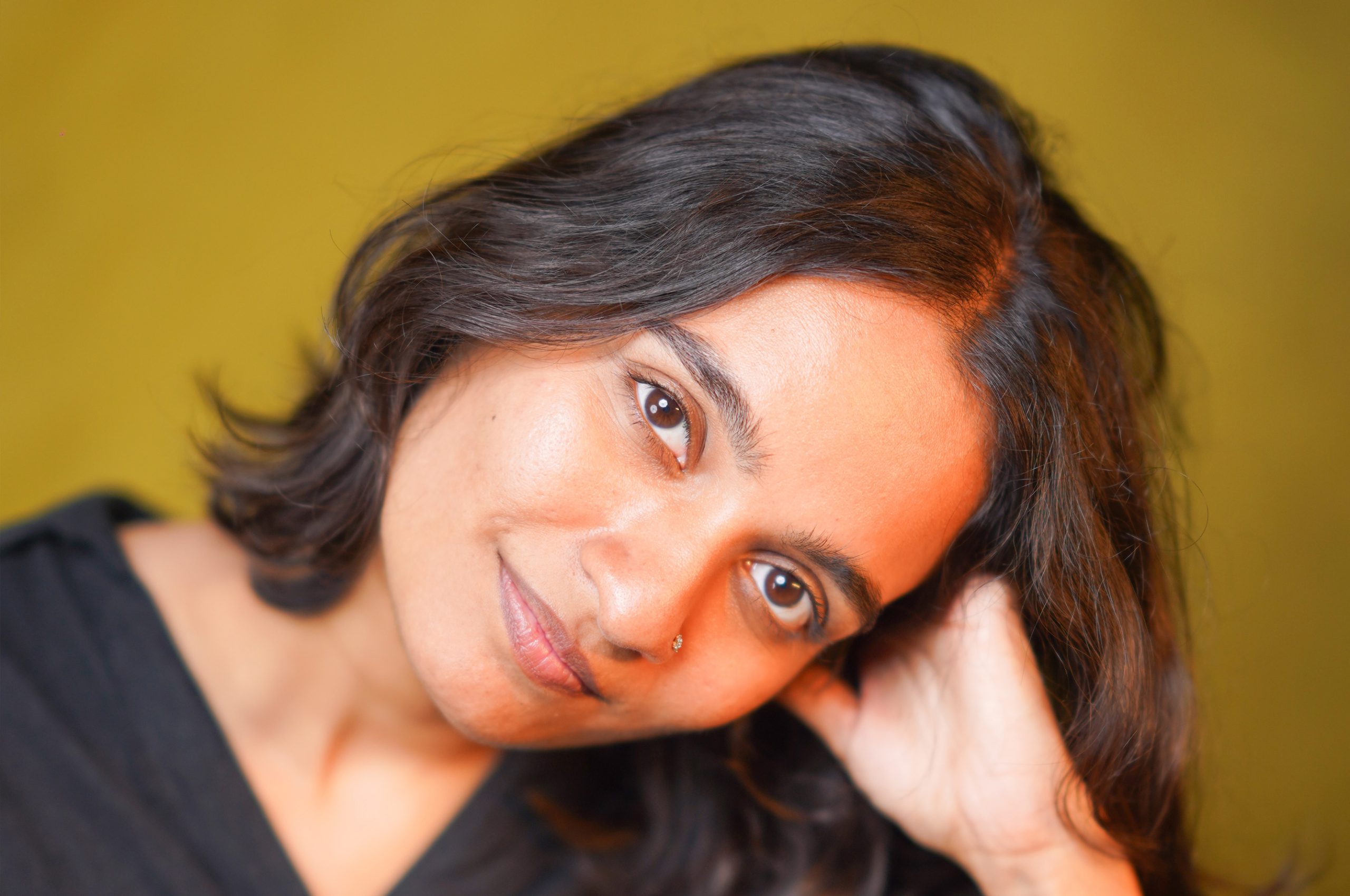
A star is born? Perhaps an entirely new vision has arrived! Tamil cinema has seamlessly stepped into a fresh era, guided by a bold female gaze. This debut cuts deep. She enters the industry with a prestigious lineage: Vetrimaaran’s assistant, himself a protege of the legendary Balu Mahendra, who was profoundly inspired by Satyajit Ray. That’s a cinematic pedigree worth noting, and she is Varsha Bharath. Following the release of her exhilarating and daring film Bad Girl, we caught up with her for an exclusive chat. Unapologetic and driven, she clearly means business.
Tamil cinema hasn’t seen a female gaze like this in a long time. How personal was this perspective for you?
It was very important for me because, growing up, I never felt represented. I always wanted to create something I could watch myself. And now I feel like I’ve made that. Just days after the release, here we are, with so many people telling me they’ve never felt so seen and heard in an Indian film. I’m very happy with how it has turned out. I will keep doing whatever feels natural to me. And I won’t do this alone—I’ll tell, at any point, whatever story comes naturally to me.
We know the story of the text you sent to Vetrimaaran sir to become his assistant director. But I’m curious what happened before that? When did the idea for the film first take shape, and what was the defining moment that pushed you to pursue it seriously?
I didn’t realize it before I joined as an AD. I was just in college, thinking I wanted to do something in films. I was a little aimless. I decided to give it a shot. But once I started working as an AD, it was so much fun. I didn’t want to do anything else.
I’ve always been a movie buff. I’ve always loved watching movies. Growing up, I’d rather watch a movie than study. And as Indians, we’re all movie buffs, right? Movies are such a big part of our lives. So, yeah.
Can you name a film you enjoyed watching growing up?
Aadukalam. I really liked Padayappa.
So, can we expect something like that? A film in the commercial realm of Padayappa?
Isn’t Bad Girl like Padayappa? (Smiles)
What pushed you to tell this story of Bad Girl now?
Now is when I got the opportunity to make a movie. If I had found a producer and had the intelligence to do it 10 years ago, I would have. But now, I was ready to make a film. I was also writing 2–3 projects on the side, and this one ended up getting made.
Was this the first script you wrote to kickstart your career?
I had actually written three scripts, two of them were films, including this one, and I had also put together a pitch deck for a series. I pitched everything in parallel, and this one ended up getting made.
In an interview, Vetrimaaran sir mentioned that if you had brought him a different story, he might have asked you to approach another producer, but this one clicked. What do you think made him decide to produce this film?
Maybe it’s the fact that no one else would have produced it. He knew I needed him for this film because in the hands of any other producer, it wouldn’t have been made. A lot of people are appreciating me for this movie, but the one who really deserves the appreciation is him. It doesn’t take guts to tell a story like this; it’s your life, it’s what you know. That part is easy. But it takes guts to produce something like this. So, I feel what made him do it is the belief that no one else could have, and his absolute conviction that this story deserves to be told, this voice deserves to be heard.
In the first 40 minutes, men in the hall seemed restless as Ramya spoke about her sexuality. But then came that “slap” — breaking generational patriarchy through her mom, with her grandmother’s words. Silence followed, and everyone was hooked. Was that intentional?
No, not really. I felt I was doing it from the first scene. A movie is 50% what you create, 50% how people watch it. You can’t box people that way. I think audiences are complex and beautiful. And honestly, the whole A-Center, B-Center, C-Center thing is bullshit. Audiences are complex and heterogeneous, you can’t “piruchufy” it as male or female. People from all walks of life have embraced this film, and that’s what makes it beautiful.
In an interview, it was revealed that the ending of the film was altered for the theatrical audience, and it was changed because of the politics. Can we know what was conveyed through it?
Not for political reasons. We wanted to make a movie, not for politics, not for commerce. The intention was to reach women, to reach people. Movies aren’t meant to be watched in isolation; they’re meant to connect with audiences. While sensibilities matter, my need to be different shouldn’t alienate anyone. We wanted everyone to feel included, and that’s why the change was made: to be more inclusive, beyond politics.
What was the original ending, and do you feel the final ending still carried the punch you intended?
It was a version where you don’t see Ramya making peace with her mother. We left that arc open-ended. And it definitely seems to work theatrically. In every show I’ve seen, one common factor is that the moment really resonates with people. I’m grateful I made that call, and grateful to my producer for suggesting it.
Your mentor, Vetrimaaran, is known for embracing imperfection. But you chose precision and detail. Why take that route?
I think it was so fast and so starkly different that you didn’t notice the imperfections right away. It’s a really imperfect movie. People who have watched it more than twice have pointed out those flaws, and yes, if you look closely, you’ll see them. Unfortunately. But having said that, I’m also very proud of being his assistant. I’m proud of my mentor and everything I’ve learned from him. At the same time, I want to make movies that are different in presentation. With this film, I followed his style quite a lot. In my future work, I hope to find a different voice and do something of my own.
Can you name something that you borrowed from his style?
The dubbing. I changed a lot of lines during the dub, and I changed many things in post as well. In many ways, the movie was born on the edit table. I had shot scenes with a certain intention but later shaped them differently. My actors would often ask, “What is that scene?” because they didn’t even remember shooting it that way. Sometimes we filmed a scene in one context, but in the edit, I restructured, redubbed, and placed it in an entirely different context. More than once, the cast was stunned when they finally watched the film, because what they saw on screen was very different from what they experienced while shooting.
In Tamil cinema, we haven’t often seen female directors sustain a long career. Does that create added pressure for you to prove yourself with every project?
It’s not because I’m a female director. As a human being, I want to build a good career, so of course, I’m anxious. But my concern isn’t about gender; it’s about other people’s track record. Everyone has their own journey as a filmmaker, artist, or writer. For me I’m just curious and excited to see what comes next.
Have you moved on from Bad Girl and started writing your next one?
Almost. Just now. I have just started writing. I’m actually working on three very different projects in parallel. Each one is more distinct than the last. Even though the stories and plots are completely different, anyone who’s seen Bad Girl will recognise my touch in them.