

I will admit something that may get me into trouble with more serious art people: I do not always know what I am supposed to feel in a gallery. I feel excited at the prospect of viewing some beautiful or unique art, at doing something highbrow and cultural when my choice of entertainment is generally lowbrow. While sometimes I have been genuinely moved, there have been plenty of times when my reaction is more “I don’t get it but let me stand here and look pensive anyways.”
But what I have come to understand is that the best art spaces do not demand that you arrive fully formed as an art expert. They invite you in, and give you room to look, to wonder, to ask questions, and sometimes, if you are lucky, to have a conversation that changes the way you see what is in front of you. This is what I have always admired about Director Ashvin E. Rajagopalan and CEO Priyanjoli Basu of Ashvita’s. Their dedication has never been simply to present art as something to be seen, admired politely, and then left behind. They have always seemed far more interested in art as something to be experienced, discussed, contextualised, and lived with.
Their new Flagship space in Chennai demonstrates this beautifully.
Ashvita’s, founded in 2002, has long occupied an important place in the city’s cultural landscape. With a primary focus on the Madras School of Art, the gallery has spent more than two decades exploring the artistic development of this region, from pre-independence and modern art to contemporary and regional practices. Its programme has included over 100 exhibitions, and in recent years, Ashvita’s has worked with galleries across India to bring the Madras School to a wider audience. The gallery represents and engages with artists such as Alphonso Arul Doss, R. Varadarajan, P. Perumal, A.P. Santhanaraj, T.R.P. Mookiah and Achuthan Kudallur, while also working with contemporary artists including Thukral & Tagra, Raghava KK, G. Gurunathan, C. Krishnaswamy, Maanas Udayakumar and Jagath Ravi.
That sounds impressive on paper, of course, but the real charm of Ashvita’s has always been that it does not treat art history like a dusty textbook. There is a distinctly Madras way in which its work is contextualised: rooted, specific, layered, and aware of place. It makes you feel that art is not something happening elsewhere, in intimidating grand spaces in Delhi, Mumbai, London or New York. It has happened here, is happening here, and deserves to be understood from here.
The new Flagship takes that idea and gives it a physical form.
Designed by architect Faisal Manzur, the space is described as a one-of-a-kind art salon where art, conversation and collecting come together. And from the moment you enter, you feel that this is not going to be a standard walk-in, walk-around, walk-out gallery visit. The entrance opens into a distinctive circular lobby inspired by the Gajabrishta form, with three sets of double doors leading into three different spaces. There is something wonderfully theatrical about it. It feels almost like a polite, beautifully designed version of a mystery novel: choose your path.
I loved this immediately because it changed my mood before I had even seen the exhibition. Instead of being directed in one obvious way, I felt invited to explore. Each set of doors offered a different possibility. Behind one, the focused quiet of the gallery. Behind another, the more strategic, conversational energy of a boardroom. Behind the third, the comfort of a living room. It made the visit feel less like viewing art on a pre-decided route and more like entering a home, a mind, or perhaps even a private collection that has slowly decided to reveal itself.
The first set of doors leads to the new White Cube Gallery, currently exhibiting Mimesis, a new body of work by Thukral & Tagra. This room is stark, bright and disciplined in the best possible way. The walls are white, the ceiling holds two enormous panels of light, and everything in the space seems designed to remove distraction. There is nowhere for the eye to wander lazily. The artworks become the focus, as they should.
Mimesis itself is an interesting exhibition to encounter in this space because the work plays with the tension between the digital and the tactile, speed and slowness, abstraction and feeling. Emerging from Thukral & Tagra’s ongoing series Arboretum, which explored communities of trees, memory and living archives, Mimesis moves from organic ecosystems into digital terrains. The works are composed of imagined data forms — painted canvases filled with pixels, bars and fragmented visual units that appear at first to belong to the language of technology, but on closer viewing reveal the hand, patience and materiality of painting.
This is where the exhibition becomes particularly relevant to the lives we are all currently living, whether we think of ourselves as “art people” or not. We are all, in some way, being translated into data. Our memories become photo archives. Our moods become playlists. Our relationships become message threads. Our tastes become recommendations. Our locations, habits, purchases, faces and preferences are constantly measured, sorted and reshaped by systems we barely understand but obediently use every day. We move through the world leaving invisible trails of ourselves behind.
Mimesis asks what happens when lived moments become units. Can pixels hold memory? Can code hold intimacy? Can a visual system that looks almost clinical also carry traces of emotion, absence, surveillance or care? There is something quietly unsettling about that question because the answer, in our own lives, is already yes. We do feel things through screens. We do grieve through photographs. We do maintain closeness through little blue ticks and voice notes. We do archive ourselves constantly, sometimes lovingly and sometimes compulsively.
And yet, here, those ideas return to painting. That is the part I found most compelling. Technology is always asking us to move faster. Refresh, scroll, reply, upload, update, repeat. Art asks for something else entirely. It asks you to stand still and to keep gazing; to resist the urge to understand in two seconds and move on. In Mimesis, the visual language may suggest digital speed, but the act of painting insists on slowness. Hundreds of canvases, each with its own imagined data form, become a way of giving material weight to the fleeting and invisible.
After the sharp clarity of the white cube gallery, the second set of double doors leads into a boardroom, and this is where the Flagship begins to reveal its broader ambition. This is not just a place to view art; it is a place to gather around it. The room is anchored by a large marble table, the kind that immediately suggests serious conversation, decisions, perhaps even deals. But around the edges of the room are shelves that soften that formality. They hold some of Ashvin’s artefacts, along with other objects and products connected to the world of Mimesis and Thukral & Tagra.
I liked this room because it acknowledges something people do not always say aloud: art has a social and economic life too. It is collected, discussed, negotiated, supported and placed. A boardroom in an art space could easily feel too businesslike, but here it feels appropriate. After all, collecting is not only about acquisition. At its best, it is about stewardship, curiosity and commitment. It is about deciding that certain works, certain artists and certain histories matter enough to be lived with and preserved.
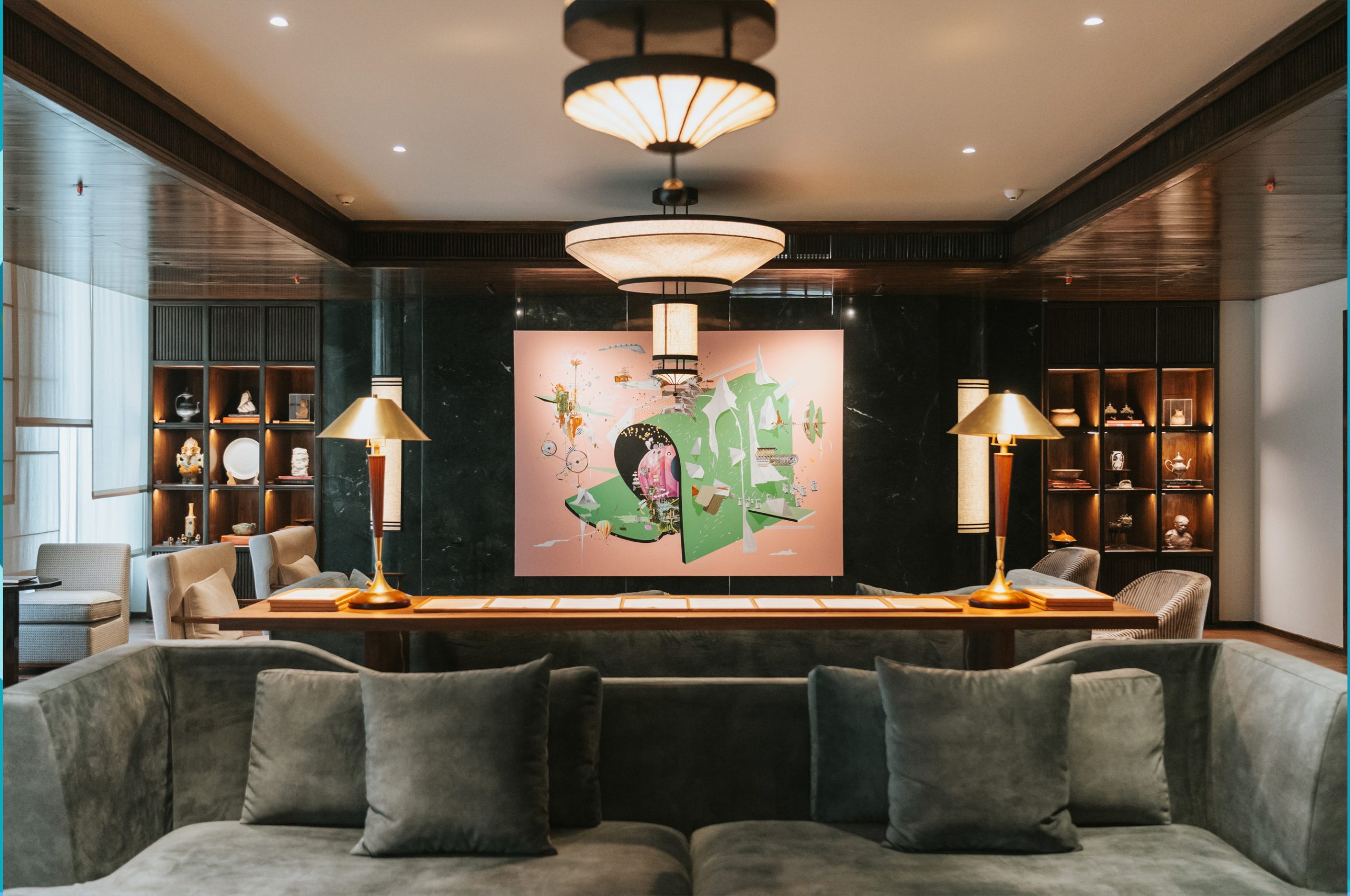
The third set of double doors opens into what may be my favourite part of the Flagship: the living room. It is elegant and warm, with rich wood finishings, dark green marble, and seating that manages the rare trick of looking both opulent and genuinely comfortable. This is not furniture that merely wants to be photographed. It wants you to sit down.
And that matters more than we might think.
In the living room, two large works by Thukral & Tagra command attention, but you are not expected to stand stiffly in front of them while pretending your feet don’t hurt. You can sit comfortably and take them in. And then, as others sit around you, the experience begins to change. What started as a private encounter becomes social. Someone notices something you missed. Someone asks a question. Someone makes a comment that opens up the work in a new way. Suddenly, art is not just an object on a wall. It is a reason for people to gather.
This, to me, is the most successful aspect of the Flagship. It understands that the way we encounter art affects what we receive from it. A painting seen while standing alone in a silent room is one experience. The same painting seen while seated comfortably, with another person beside you saying, “Wait, look at that part,” is something else entirely. The space allows for both.
There is also something quietly radical about creating a salon-like art space in Chennai at this moment. We are a city with deep cultural memory, serious artistic histories and an audience that is often more curious than it is given credit for. But many people still feel that galleries are not “for them”, unless they are collectors, artists, students or people who know exactly when to nod. Spaces like this help break that invisible barrier. They suggest that art can be engaged with intellectually, aesthetically, socially and even comfortably.
Ashvita’s Flagship feels like a bridge: between the Madras School and contemporary practice; between viewing and discussing; between the solitary act of looking and the shared pleasure of conversation.
It is open Tuesday to Saturday, from 4 pm to 7 pm, by appointment only, which also feels right for a space like this. It is not asking to be consumed in a rush. It is asking for time. And perhaps that is the larger invitation here – not just to see art, but to slow down enough to experience it.
In a city where we are often racing between school pick-ups, traffic, work calls, family obligations and the general daily circus of urban life, stepping into a space that asks you to pause is no small thing. The new Ashvita’s Flagship does not simply display art. It creates the conditions for attention. And in today’s world, attention may be one of the rarest luxuries of all.