

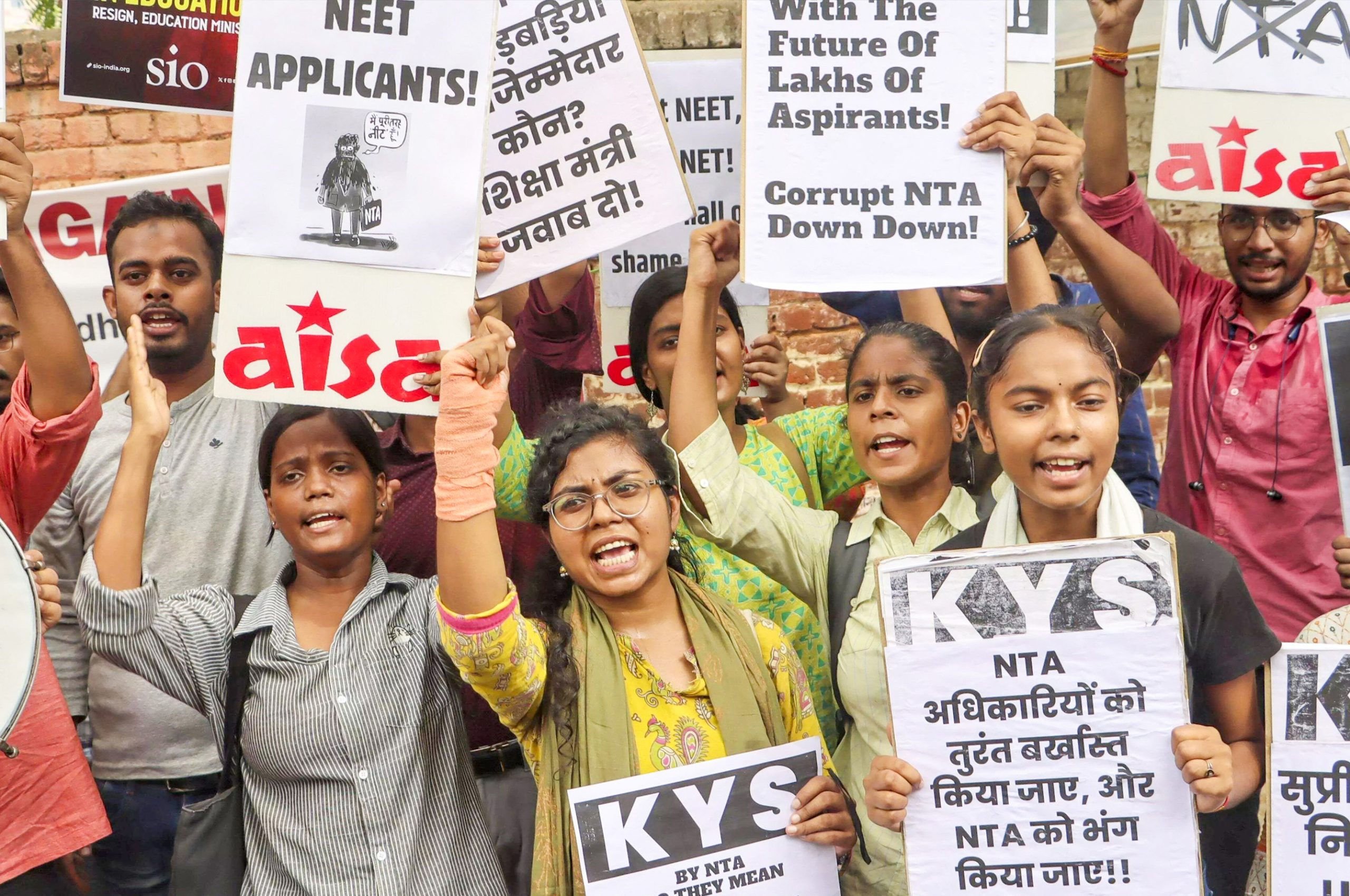
India as a land has seen public dissent through almost every part of its history. But it is safe to say that it has seen little quite like the recent wave of Gen Z-led protests. It didn’t stop at Jantar Mantar; it also brought attention to the Jharkhand student agitation, which had remained largely in the shadows for some time.
This recent student movement offered something different. Not necessarily because young people had suddenly discovered politics, but because they entered an existing political struggle with a language and culture of their own. To understand what made this movement different, we looked closer at the Chennai protests through the perspective of Dhivya, a social activist and one of the recognisable faces of the Balan Illam protest.
A ‘Different’ kind of protest
At the centre of Chennai’s demonstration was Balan Illam, the CPI’s state headquarters in T. Nagar. Unlike a conventional protest that occupies a public road, square or government premises, the sit-in took place within a private political space. That distinction mattered.
For many participants, it offered a protected environment to express dissent without the immediate fear of being detained or pushed away from a public space.
Dhivya, a social activist and member of the Indian Society of Cultural Cooperation and Friendship (ISCUF), was among those involved in the protest and eventually became one of its recognisable faces. She observed a significant difference between Balan Illam and many of the protests she had previously witnessed.
“Many of whom were new to politics and people’s issues,” she said, describing the young people who joined the movement. That may be the most important detail about Balan Illam. The protest did not merely attract people who were already politically organised. It opened a door for people who had previously remained outside conventional political spaces.
That accessibility changed the nature of the gathering.
The protest became a space
At Balan Illam, protest went beyond slogans and speeches.
“When people come together for a cause, song, dance and art follow,” Dhivya said.
Young participants wrote rap songs on the spot, recited poetry, made posters, staged plays, painted, played Parai and danced. One canvas invited protesters to draw their own versions of the movement’s “cockroaches”. Another booth allowed them to pose with a placard of Anitha and the hashtag #BANNEET. Letters to political leaders were written at another table, many of them sarcastic and angry.
Some stayed through the night. People ate together, made friends and took care of the space without being instructed to do so. Supporters who could not attend sent food, water and electrolytes. For Dhivya, there were echoes of the 2017 Marina Jallikattu protest, where the protest site had similarly developed into a temporary community. She recalled over 6000-7000 student walked in through the course of the protest.
A young person did not necessarily need to arrive with a political organisation behind them, know how a protest was traditionally conducted or even have previous experience of street politics. They could write, paint, perform, document, organise food or simply be present. And perhaps that is where the Gen Z aspect of the movement becomes most revealing.
The language of the internet enters the street
Gen Z has often been described as distracted, unserious and too absorbed in the internet to engage meaningfully with politics. Balan Illam challenged that assumption.
The humour, sarcasm and visual language that dominate online culture did not disappear when young people stepped into a political space. They brought them along.
For Godwin Immanuel, a media researcher and PhD scholar in Bengaluru, humour itself became a tool of dissent. “Humour was one of the tools,” he said, pointing to the use of memes, sarcasm, jokes and even AI-generated videos as contemporary methods of protest.
The significance lies in the fact that these weren’t simply ways of making a protest more entertaining. They were ways of communicating political ideas in a language that young participants already understood. The conventional protest might depend on the speech, the slogan or the placard. Balan Illam had all three, but it also had the meme, the reel, the rap and the sarcastic poster. The politics remained serious. The language did not always have to be.
The protest didn’t stop at the street
If Balan Illam was the physical space of the movement, social media became its second location. Instagram, particularly, allowed participants to document what was happening in real time. Protesters became broadcasters. Reels captured songs, speeches, artwork and crowds. Alternative digital news outlets offered another source of information at a time when participants felt mainstream coverage was inadequate.
For Dhivya, social media functioned as more than a record of events. It helped mobilise people and expose what was happening on the ground.
Godwin similarly pointed to the emergence of young people creating their own media channels and using memes, images and videos to circulate their version of events. But the same system that gives participants a direct voice also carries its own risks.
Social media is, as Dhivya described it, a “double-edged sword”. Its visual and rapid-fire nature can encourage quick reactions over considered political discussion, while misinformation can spread as quickly as genuine reporting.
That contradiction is important. The lesson from Balan Illam isn’t that social media has replaced journalism or political organising. Rather, it has changed the relationship between the protester, the journalist and the audience. A participant no longer has to wait for a television channel or newspaper to decide whether their protest is worth showing. They can record it themselves and distribute it within seconds.
Speaking beyond Tamil Nadu
One of the most striking moments of the Chennai protest came when Dhivya raised the slogan “Azadi” in Hindi.
For someone who has consistently opposed Hindi imposition, the choice could appear contradictory. But Dhivya explained that the intention was solidarity with students facing repression elsewhere in the country. She asked the audience if they would join her in raising the slogan in a language that students in northern India could understand, while translating each line into Tamil.
The moment captured another characteristic of this new political space: a movement rooted in Tamil Nadu attempting to communicate beyond it.
What comes after the protest?
The fight against NEET did not begin at Balan Illam. Student organisations and activists have been opposing it for years. The protest therefore wasn’t the birth of the movement. Its significance was different. It showed what happened when an existing political struggle encountered a generation that had not traditionally taken to the streets.
They brought their own humour, art, digital communication, community and a willingness to turn a protest site into a lived space. That doesn’t automatically make them more political than previous generations. Nor does one successful mobilisation prove that a permanent political movement has emerged. But Balan Illam offered a glimpse of something worth watching. Perhaps the question is no longer whether Gen Z is political.