

The evening air in Chennai has a heavy, humid weight, like the breath of the monsoon before the clouds finally break. I was sitting by my window, watching the shadows stretch like tired ghosts across the floorboards. The day’s work—if one can call the frantic scratching of a pen on paper work—was done, and the tea in my chipped enamel mug had long since grown tepid. It was in that quiet stretch of twilight, that liminal space between the bird’s last song and the cricket’s first chirp, that I reached for my pocket—a habit now as involuntary as the beating of one’s own heart.
I had intended, quite reasonably, to check the state of the world. Just a glance at the headlines, the murmurs of distant conflicts, the fretful shifting of nations—Iran, Israel, the Americans hovering like crows on a wire, waiting to see which way the wind blows. Just a moment, I told myself—a quick look to see if the world was still spinning on its axis.
But the phone, that small, glowing talisman, has a way of turning a moment into an eternity.
The first video played, with its sharp, urgent rhythm—a frantic dance of pixels and sound. Before the screen could fade to black, another appeared. And another. It was like watching a river in spate; I was merely a leaf caught in the current, spinning, rushing, entirely at the mercy of the stream. My mind, usually prone to wandering toward the hills of Mussoorie or the rhythmic song of a mountain thrush, was suddenly held captive by an architecture I could not see, yet felt pressing against my consciousness with the weight of a physical hand.
It felt like rest. It felt like I was merely catching up with the march of history. But as the night deepened and the room grew dark, a stray, unsettling thought—sharp as a thorn—settled in my chest. I wasn’t resting. I was working.
The Invisible Loom of the Modern Age
We have always understood labour through the language of visibility. A uniform, a desk, a factory floor, the rhythmic clatter of a typewriter, a salary credited with the regularity of the tides. Work was something you could point to, something you could measure in sweat, in ink, or in the dull ache of one’s shoulders at the end of the day.
But what if work no longer looks like work? What if it has shed its skin, becoming as intangible as the evening mist?
We have entered an age in which living has become a form of production. Every click, every hesitation, every fleeting moment where your eyes linger on a photograph of a stranger’s breakfast or a politician’s grimace is not merely an action—it is raw data. It is a signal, a pinprick of information fed into the great, insatiable maw of the machine.
Platforms like Google and Meta are not merely tools; they are vast learning systems. They do not simply record our behaviour; they interpret it. They anticipate it. They are like a master gardener who knows exactly when the flower will open, watering the soil of our attention just enough to keep us rooted.
And somewhere within that process, a subtle, almost imperceptible shift occurs. We believe we are using these platforms to connect, to learn, to be entertained. In truth, we are training them. We are the architects of our own digital confinement.
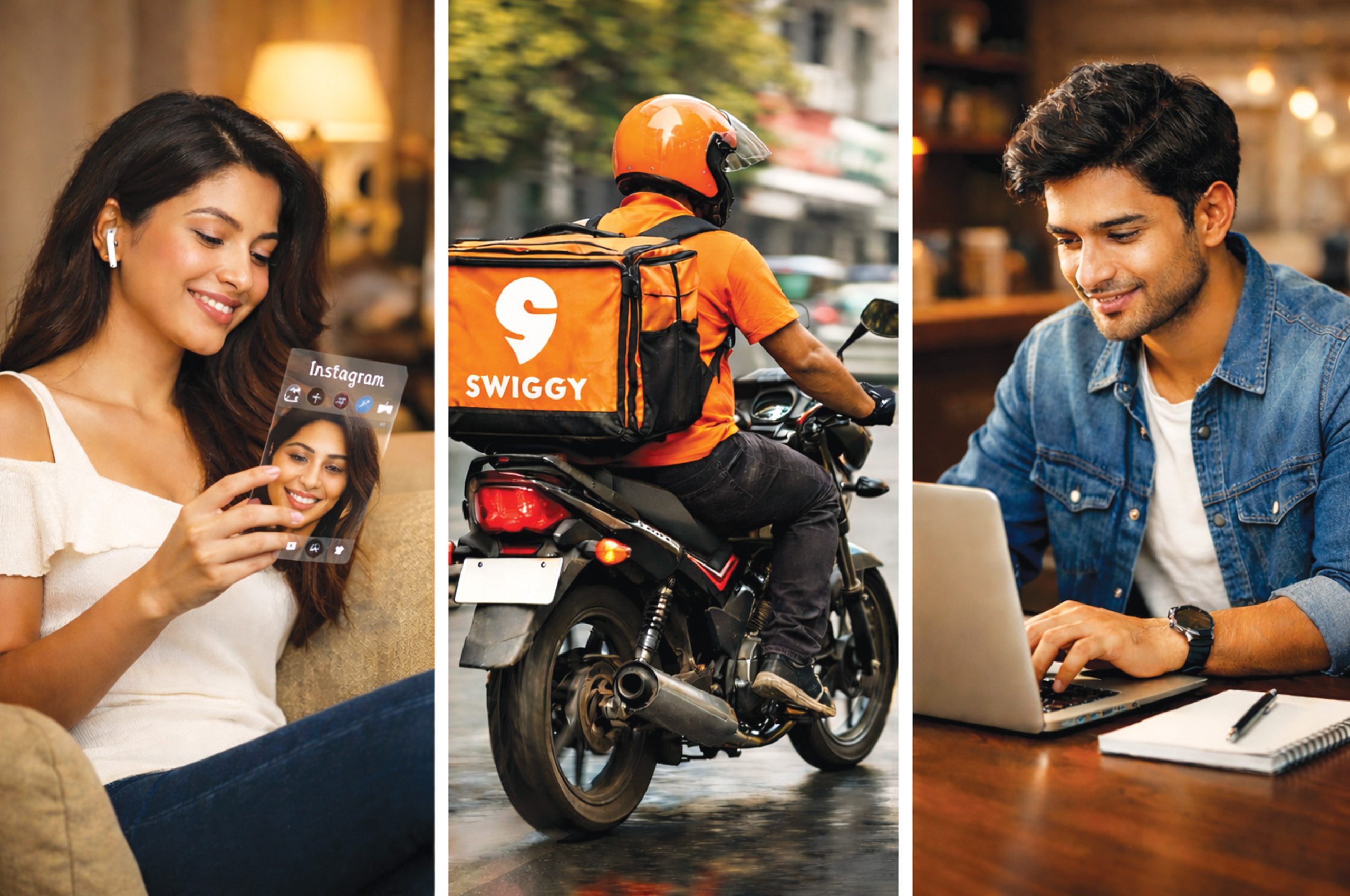
Consider the Swiggy rider in Velachery—let us call him Aravind. He sits on his motorbike, the Chennai heat radiating off the asphalt, waiting for the ‘ping.’ With every route he takes, every shortcut he discovers, every moment he spends navigating the labyrinthine streets, he is teaching the algorithm how to be more efficient, how to extract more from his labour for less reward. Consider Kavya, the teenager in Adyar, scrolling through a waterfall of short-form videos. With every pause, every ‘like,’ every skip, she is sharpening the system’s understanding of human emotion. She is teaching the machine what makes her cry, what makes her laugh, what makes her afraid. She is providing the training data that will, eventually, make her own presence irrelevant.
When I moved from one video to another, I was not merely wandering. I was mapping myself. Piece by piece, I was constructing a digital effigy of my own soul, one that could be bought, sold, and manipulated by those who hold the keys to the kingdom.
The Great Extraction: Quiet, Constant, and Cruel
There was a time when extraction was a visible, dirty business. It looked like coal mines, like the soot-choked chimneys of the Industrial Revolution, like machines that roared and hissed and demanded flesh and blood. Today, the extraction is quieter. It hums beneath the surface of the screen, a soft, electronic murmur.
It looks like the ‘infinite scroll.’ It sounds like the polite chime of a notification, a sound that cuts through the silence of a library or the sanctity of a bedroom. It feels like a choice, but it is, in fact, design.
The modern digital economy operates on a single, ruthless principle: Capture attention. Hold it. Monetise it. Everything else—our well-being, our privacy, our ability to think a coherent thought—is secondary. The feed is designed to have no ‘stopping cues.’
There is no natural conclusion, no moment where the page turns and the book ends, allowing you to close it and return to the world of men and trees. Instead, there is always one more: one more story, one more reaction, one more outrage.
And at the heart of this machine lies the architect’s genius: the weaponisation of dopamine. It is not, as we are often told, the chemical of pleasure. It is the chemical of *anticipation*. It is the itch that begs to be scratched. It is released not when you receive it, but when you expect it. This is why the scroll never ends. You are not chasing satisfaction; you are chasing the *possibility* of it. The next video might be the one. The next post might be the one that changes everything. This is not addiction in the crude, old-fashioned sense. It is a marriage of design and biology, a system that understands the human mind better than we understand ourselves. It extracts not by force, but by invitation. And that is the most insidious form of slavery: the one where the enslaved person believes they are free.
The Illusion of Choice and the Death of Contemplation
We cling to the belief that we are the masters of our devices. “I choose what I watch,” we say. “I decide when to put the phone down.” In a narrow, legalistic sense, this is true. But the modern system does not remove choice; it shapes the environment in which that choice is made. You open an app to send a message, and you are shown three more, all curated to keep you within the walls of the digital fortress. You feel like you are exploring, like you are a free agent in the vast landscape of the internet, but you are being guided as surely as a sheep through a chute.
The cost is not immediate. It is slow, like the erosion of a cliff face by the sea. Our attention becomes fragmented, our capacity for depth withers. We skim; we do not read. We react; we do not reflect. The mind loses its ability to stay, to linger, to contemplate the slow turning of the seasons or the quiet beauty of a sunset.
We have traded the infinite richness of the real world for the frantic, hollow speed of the digital one.
As Nicholas Carr so wisely noted, the internet is chipping away at our capacity for concentration and contemplation. And as that capacity erodes, something deeper shifts. Our identity becomes plastic. What we see, we become.
If we engage only with the frantic, the angry, and the superficial, we begin to echo those qualities. We become reflections of the algorithm’s design. We begin to wonder: are these my thoughts, or are they merely the echoes of a machine that has learned to simulate me?
The New Labour Class: An Unseen Army
Labour once had a dignity of place. A worker in Ambattur had a trade; a vendor in Koyambedu had a market. There was a clear contract between effort and reward.
Today, labour has undergone a metamorphosis. It has moved from the physical to the cognitive. The factory has not disappeared; it has simply migrated into the palm of our hand.
Old Labour was physical, defined, and limited by the ticking of the clock. New Labour is cognitive, fluid, and ‘always on.’ There are no unions for the digital labourer, for how can you organise a class that does not even recognise that it is a class? We are all, in our way, workers in this invisible vineyard.
We label data for the machines; we train the intelligence that will eventually replace the clerk, the writer, the illustrator, the driver.
We are, to borrow a phrase, the fuel of the AI age. Every time we interact with these systems, we are providing the carbon that keeps the fires of artificial intelligence burning. And the tragedy is that we are doing it for free, often paying the price with our time, privacy, and peace of mind.
Reclaiming the Soul of the World
Must we burn the ships? Must we return to the Stone Age? No. The answer is not total rejection, for that is a luxury few of us can afford. The answer is *awareness*.
It is the act of the pause. It is the decision to unlock the phone only when one truly needs to, and to lock it the moment that need is met. It is the conscious return to the breath, to the stillness, to the world that exists outside the glow of the screen.
In a world that is designed to pull our attention outward, reclaiming it—drawing it back into the quiet chambers of the mind—is an act of profound, revolutionary resistance. It is not withdrawal; it is a declaration of sovereignty. As Cal Newport once suggested, clarity about what matters provides clarity about what does not.
When you set the device down, the world does not collapse. The sun continues to trace its arc across the sky. The birds do not stop their singing. The rain continues to fall on the thirsty earth. These things are real. They do not require a Wi-Fi signal to be true.
This May Day, as we celebrate the worker, let us remember the visible ones—the ones who build our houses, harvest our grain, and weave our cloth.
But let us also look at ourselves, the new, invisible labourers, and ask what it is we are building. Are we building a future where humanity is enhanced, or one where we are slowly digested by the very tools we created?
The factory of the future is not a building. It is a state of mind. It is a place where every second of our lives is mined for value. We walked into this factory willingly, carrying our screens like passports to a new world.
But we need not remain prisoners. We can step out. We can walk through the gates. We can look up, breathe in the air, and remember what it is to be a human being, untracked, unmonetised, and beautifully, wonderfully free.
For, in the end, a life lived through a screen is a life lived in the shadow of a dream. The real world—with all its messiness, its beauty, its sorrow, and its joy—is waiting just outside the window. And it is the only place where a soul can truly find its rest.
So, this May Day, as the flags flutter and the speeches begin, let us cast our gaze beyond the dusty streets and the factory gates.
Let us look at the quiet, glowing rectangles in our own palms. We are all, in our own small and silent way, part of the workforce now. We are the new proletariat, weaving a tapestry of data that no one—not even we ourselves—fully understands.
We toil not in sweat and steel, but in clicks and scrolls, forging a world that harvests our very attention for its own cold, mechanical gain. Perhaps, then, this day belongs to us all, for we are all prisoners of the feed and architects of our own distraction.
But remember this, as the evening shadows stretch: when the screen finally goes dark, and the notifications cease their frantic tapping, the world that waits outside is the only one that truly knows your name. Step away from the machine, breathe the evening air, and reclaim the only labour that ever really mattered: the work of being human.
Dr K. Jayanth Murali
is a PhD in Microbiology and a retired Director General of Police with a distinguished career in public service. He is the author of nine books, including the bestsellers 42 Mondays and Chasing the Lost Gods, and is also a record-holding marathon runner. Based in Chennai, he lives with his family and continues to pursue his twin passions of endurance running and reflective writing. When not on the road, he can be found at his desk, crafting stories shaped by life, observation, and experience.