

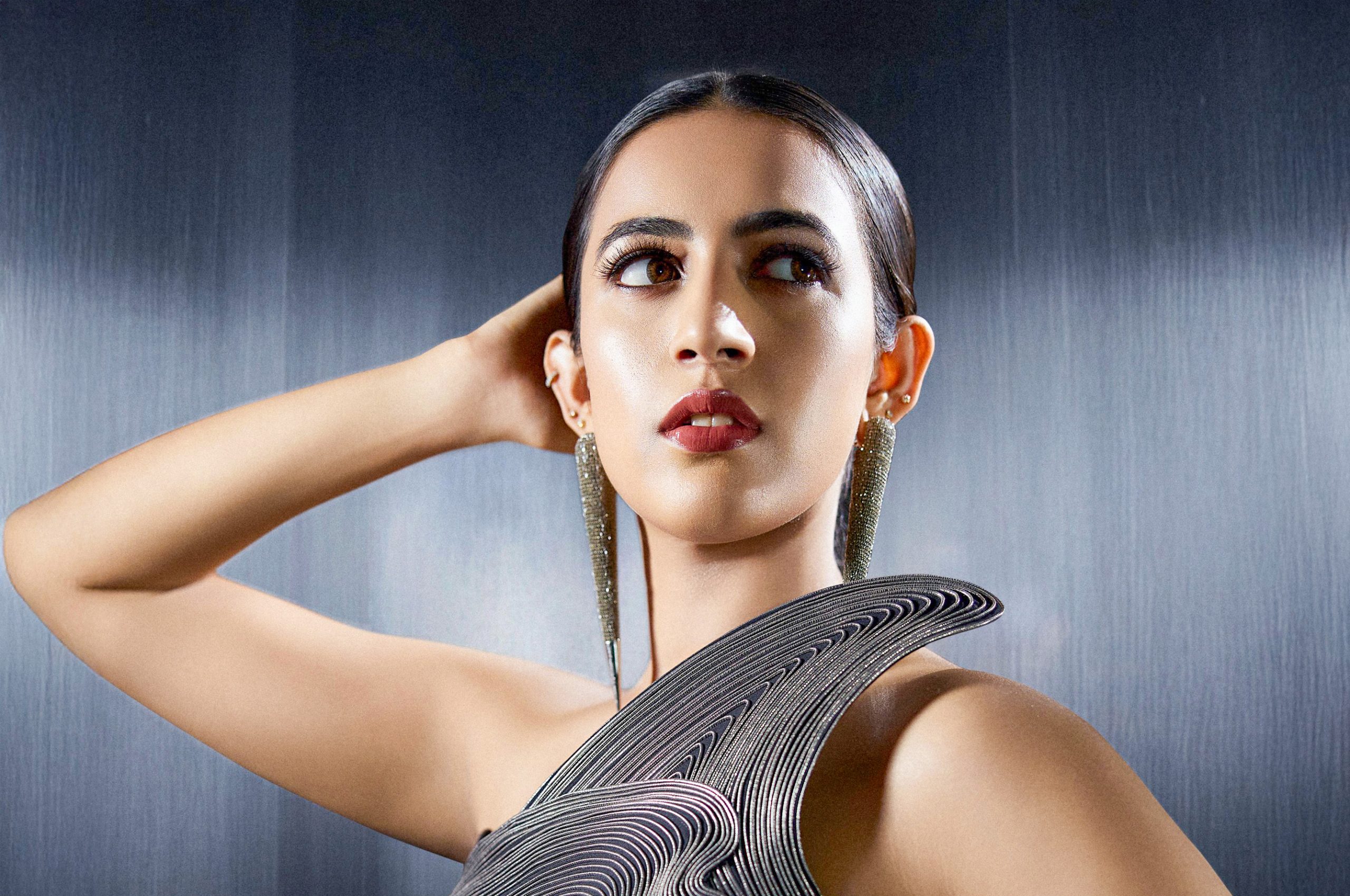
Actor, producer Niharika Konidela’s production company ‘Pink Elephant Pictures’ completed a decade this year. Today the banner stands stronger, releasing critically acclaimed films like Committee Kurrollu with festival recognition at IFFI Goa, and securing prestigious awards like Gaddar Film Award 2024 and GAMA Dubai 2025 in addition to web content, and reality shows, and a bunch of promising films lined up as an actor.
The latest jewel on her crown was the most prestigious National Award for Committee Kurrollu. The film has scripted history at the 72nd National Film Awards announced last month, winning Best Telugu Feature Film, the highest honour for Telugu cinema. Adding to the celebrations, P. Ravi Kumar, who worked on the film was honoured with the Best Make-up award, making it a landmark double victory for the film and its entire team.
“Winning my first National Film Award is an incredibly emotional and humbling moment. When we began the journey of Committee Kurrollu, we simply wanted to tell an honest story that felt authentic to our roots. This award belongs to our entire team and every person who believed in this film. This recognition only strengthens my resolve to continue backing meaningful stories and new talent, she shares on the ocassion.
The next big release for her is an action-packed sports drama titled Bhari with actor and her brother Varun Tej, directed by Yadhu Vamsee and produced under Pink Elephant Pictures. She recently wrapped up Season 1 of her dance reality show on Zee Telugu, and had a success stint with Manasa Sharma’s Rakasa with Sangeeth Sobhan in the lead. Niharika Konidela is constantly swamped with work and she is not complaining. “I love what I do”, Niharika Konidela says during an exclusive interview for Provoke Lifestyle.
Ten years ago, when Niharika Konidela put in three lakhs of her own savings to back a quirky YouTube series called ‘Muddapappu Avakaya’, she wasn’t launching a banner with a strategy deck or commercial projections. She was simply trusting her gut.
Over the years, Niharika has evolved into one of the few young women producers in Telugu cinema steadily building credibility, not noise.
The award for ‘Committee Kurrollu’ is a milestone that quietly underlines the arc of her journey: from digital-first storytelling to national recognition. The scale may have changed, but her core philosophy hasn’t.
“For me, it’s art,” she says. “Art will give you what you give it.”
Born into one of Telugu cinema’s most influential families, Niharika grew up witnessing both the euphoria of stardom and the bruises behind it — the rehearsals, the script readings, the exhaustion. The glamour, she insists, was only the cherry on top. What fascinated her was the work. The craft. The discipline. She has had a ring side view of her uncles mega star Chiranjeevi, Pawan Kalyan and her father Nagababu at work, not to mention her brother and cousins, who chose to be actors.
Yet she did not walk straight into films. She briefly worked in television to understand TRPs, ratings, and the mechanics of media. She began as an actor. She stumbled into production while trying to mount a story she believed in. And somewhere along the way, Pink Elephant Pictures became not just a banner, but a responsibility.
Unlike many producers who lean heavily on trends, Niharika insists on clarity of audience and instinct. She speaks of balancing pocket and passion with equal seriousness. She speaks of accountability — of how a failed film affects a producer differently. She speaks of collaboration, of picking the right music director or cinematographer as a business decision rooted in creative conviction.
Beyond films, her canvas has widened. With the dance reality show, Aata that she produced for Zee, she stepped into the demanding world of reality television formats. She continues to develop films and web shows, with multiple projects lined up under Pink Elephant. As an actor, she is selectively reading scripts she calls “too exciting to jinx.” One of her latest releases was the Tamil film Madraskaaran that also featured Malayalam actor Shane Nigam. Grapevine has it that she has indeed signed yet another film as lead and is quite excited about her role.
What stands out in conversation with her is not just ambition, but awareness. She talks about target groups before trends. About sisterhood before slogans. About trusting instinct over noise. About building longevity over chasing momentary validation.
Today, Pink Elephant Pictures is no longer an experiment. It is a lived journey — one that began with a YouTube series and now spans theatrical releases, OTT, festival circuits, and television.
And if there is one thread that runs consistently through her story, it is this: she does not chase. She builds.
Excerpts from an exclusive interview with Niharika Konidela, who is constantly hustling to make her niche at a very young age.
Producing takes a lot of energy. And, you are so involved in all your productions. How do you sustain it?
Producing is one thing, but being a part of it is more difficult. I keep remembering why I started this and the love that I have for it. That’s my fuel. That keeps me going.
Definitely, it’s a lot of hard work. Every industry is hard work. But when you like it and when you are invested in it, it changes the way you look at it when you work.
You worked for a television channel for a brief period. What led you there?
Yes, because I wanted to understand how it works. I worked at Maa TV back then. I wanted to know what the TRP system is and how it works. That gave me exposure.
That was the first time I heard about music labels and ratings that television shows get, and how they aim to reach certain goals. Every Thursday, when ratings came in, the entire office would be on fire. I enjoyed it. I did that right after college, and it was a good experience.
Did you always know you wanted to be in films?
I would like to think I always knew because I was very fascinated by what I was seeing. I saw how many hours it took for makeup, fight rehearsals, script readings, dancing, and even coming home with bruises from on-set accidents. I saw all of that.
As much as I liked the euphoric reactions and the glow of being a star, that was the cherry on top.
What really stayed with me was attending the 100-days function of ‘Indra’. That was the first time we all travelled by train and saw such a large-scale gathering for one person — Chiranjeevi Garu. I wondered what people were getting from watching his films or seeing how he conducted himself. It could be because of the blood bank, eye bank, and all of that too. That sense of trust — that extended family feeling — was very powerful for me.
I don’t know when that thought ripened into a desire to be in films. But I constantly watered it with everything around me — premieres, stories from home, conversations. I knew I loved this. I knew much later that this is what I wanted to do. Now I know there is nothing else I can do.
What is the story behind starting Pink Elephant?
I always call myself an accidental producer. When I was conceiving Muddu Pappu Avakai, I knew I wanted to act in it. The director said we needed money to make it. I had some money saved from doing a television show — about three to three-and-a-half lakhs. So, I put it in.
I didn’t think I was becoming a producer, but I did. Acting is using your body and mind as a vessel for emotions. Production is very different. So many lives are dependent on the decisions you take. It can make or break people. When a film doesn’t work, artists lose credibility. But 90 percent of the time, their pocket is fine. If there is one person who loses everything — self-image, heart, and pocket — it is the producer.
How do you balance art and business when you are producing?
Everyone wants to make money. But I don’t want to play games with Kalamma Thalli. I don’t want to treat cinema as just a mode of business. For me, it’s art. And art will give you what you give it.
At the same time, I need my pocket to be full. A producer can only produce great content when there is money. I want to last long. I want a balance between business and art.
I don’t believe in blindly following trends. Audiences are unpredictable. Give them what you think is the best with your sense of cinema.
Where business comes in for me is in choosing the right people for the project. If I don’t resonate with a script, I pass it. But once I choose it, I select collaborators carefully — music directors, DOPs — people whose expertise will add value.
Do your films reflect your personal philosophy?
Not necessarily. The lakhs and crores of people who watch films are not like me. People are diverse.
When you make a film, you have to fix your target group. If it’s for young audiences, make it for them. If it’s for couples, make it for them. You should not shake from that.
If it succeeds beyond that group, that’s a bonus. But you must be clear about who you are making it for.
Looking back at 10 years of Pink Elephant, what worked for you?
Ten years back, I didn’t look at Pink Elephant as something big. We started shooting in 2015 and released in 2016. That’s when I count from.
When Muddu Pappu Avakai released and got about 2.7 million views on YouTube, I didn’t even know there were that many people. I was that naive.
That was the first time I trusted my gut. And that is something I never want to stop doing. My gut has never wronged me. The times I didn’t listen to it, I got kicked. So now anything that crosses my table has to pass that gut check.
Pink Elephant is proof of what can happen when you trust your instinct.
What lessons have you learned during your 10-year journey?
Don’t chase. Attract. What truly belongs to you will come to you. It will manifest through you.
There were films I passed that later did very well. But at that point, I didn’t see a win in them for me. That doesn’t mean they were bad films. They just weren’t right for me.
You often work with new talent. Is it a conscious effort?
This is the nepotism I will do — I will work with people I’ve worked with before and also introduce new talent.
It’s not easy because the burden falls on the production house. After a few films, the bets are on you. That increases scrutiny.
Not every script I pass is bad. Sometimes it’s about where the production house is positioned at that time.
Who is your biggest critic?
My brother. And I am my biggest critic too. I only take criticism seriously from people whose feedback I value. Especially family members who’ve been in this business for long — I treat their feedback as a learning curve.
What does feminism mean to you?
The word feminism has been abused a lot. The real meaning is equal opportunity for men and women. That’s why I prefer calling myself an egalitarian.
There are bad men and bad women. Criminals exist in every gender. It is about good people and bad people, not men versus women.
Statistically, atrocities against women are higher. Women are often less physically capable of protecting themselves. So, it is important to highlight those issues.
But I don’t support people who claim feminism but don’t practice sisterhood or equality. It is not about hating men. It is about justice.
You recently spoke about debutants not getting time to speak at award functions. Why did it matter to you?
When a debutant wins an award, it is their first recognition. That moment is special. They may later win many awards, but the first one matters the most.
Even if you give them one minute, that minute will stay with them for a lifetime. If time is a concern, set a time limit like the Oscars do. But let them speak.
The future of cinema lies with debutants. Their stories inspire others to enter the industry.
Rapid Fire
One city you can escape to anytime?
Goa. Especially South Goa. It’s close, comfortable, and no one bothers me.
A film you can rewatch endlessly?
Gangubai.
Your idea of a perfect day off?
I don’t really take days off. But if I get an afternoon free to sleep, that’s luxury.
Coffee or chai?
Coffee. It runs in my blood.
A place that changed your perspective?
Bali. I went for a women’s retreat. It changed my perspective.
Are you into journaling?
Yes. Reflection is important. Reflection and distraction are very different.
Family means?
Family is my ground. Even if I fall, knowing they’re there gives me confidence to get up again.
One habit you’re trying to build?
Not a new habit — I want to get back to my hobbies. Pottery, Kathak. I’ve neglected them because of work.
Sunrise or midnight?
Midnight. I can’t sleep at 10 pm.
Mountains or beaches?
Both. I can’t decide.
Comfort food?
Tomato rasam and omelette.
One ritual that keeps you grounded?
My morning prayers at my shrine at home.